A new peer-reviewed study published in Current Plant Biology finds that Trichoderma hamatum, a beneficial soil fungus, can significantly reduce the harmful effects of drought stress in hemp while simultaneously increasing cannabinoid production.

Hemp plants (photo credit: Heather Ainsworth for The Wall Street Journal).
The research was conducted by scientists from the National Academy of Agricultural Science, Kangwon National University, and Colorado State University. Hemp plants were subjected to four treatments: control, drought stress, T. hamatum only, and T. hamatum combined with drought stress. Results showed that when applied to drought-stressed hemp, T. hamatum increased photosynthesis rates by over 300% and improved water-use efficiency compared to drought-only plants. It also restored chlorophyll content and upregulated aquaporin-related genes, which are critical for water transport within the plant.
T. hamatum also increased key secondary metabolites. When combined with drought, it significantly elevated levels of total phenolic and flavonoid content—compounds linked to antioxidant defense—and improved radical scavenging activity. Notably, CBDA and Δ9-THCA levels were both significantly higher in the T. hamatum-treated groups regardless of drought conditions.
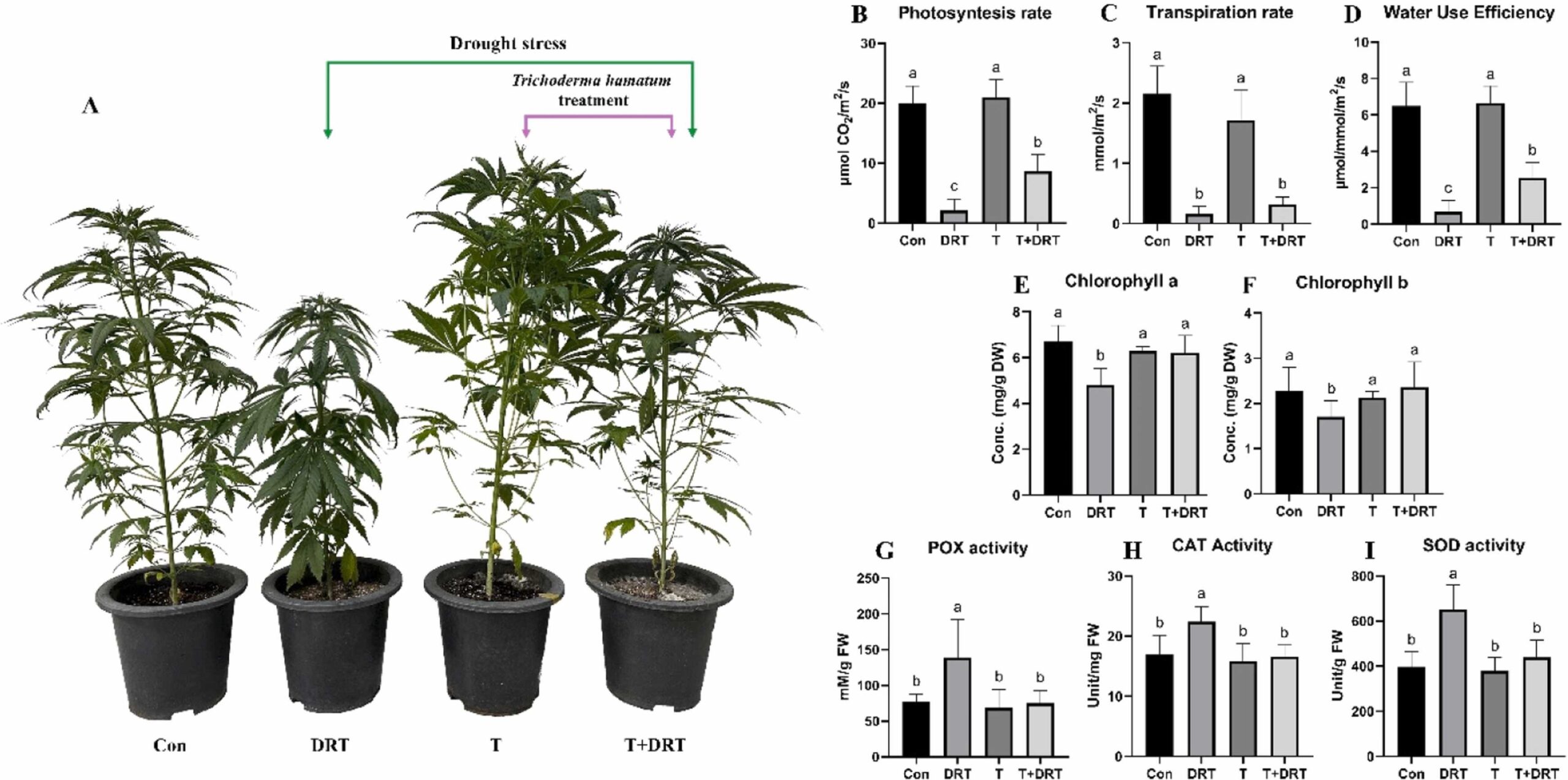
Fig. 1. Effects of drought and Trichoderma hamatum on photosynthetic parameters and antioxidant enzymes in Cannabis sativa L. cv. Pink Pepper. A: The image of C. sativa with four treatments (from left to right), Control (Con), 10 days of drought (DRT), T. hamatum only (T), and pre-T. hamatum treatment, followed by 10 days of drought stress (T+DRT). B: Photosynthesis rate, C: Transpiration rate, D: Water use efficiency, E: Chlorophyll a content, F: Chlorophyll b content, G: Peroxidase content, H: Catalase content, I: Superoxide dismutase content. Means with different letters are significant at 5% by Duncan’s Multiple Range Test (DMRT, p < 0.05, n = 9). POX: Peroxidase, CAT: Catalase, SOD: Superoxide dismutase.
Transcriptome analysis revealed that T. hamatum reversed drought-induced gene overexpression related to proline and branched-chain amino acid biosynthesis. It also restored normal expression of genes linked to stress response, light harvesting, and water regulation. More than 90% of aquaporin-related genes were upregulated with treatment.
Overall, the study highlights the potential of T. hamatum as a powerful biostimulant that improves hemp’s physiological performance and cannabinoid profile under drought stress by activating a broad range of genetic and metabolic responses.
Sponsors: