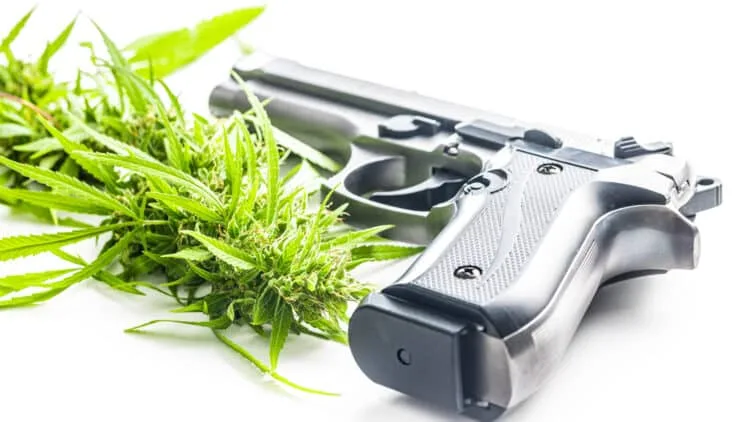

(Photo credit: jirkaejc/Newscom).
A new amicus brief filed with the U.S. Supreme Court argues that the federal government cannot categorically strip marijuana users of their Second Amendment rights without first showing that they pose a genuine danger to others.
The brief, submitted today by the Liberty Justice Center in United States v. Hemani, urges the Court to affirm the Fifth Circuit’s ruling that 18 U.S.C. § 922(g)(3) — the federal law that bars “unlawful users” of controlled substances from possessing firearms — cannot be applied to sober marijuana users based solely on their status as cannabis consumers.
The filing comes just days after the American Civil Liberties Union, the CLEAR Project at CUNY School of Law, and private counsel filed a separate amicus brief in the same case making similar constitutional arguments about vagueness and historical tradition. While that brief focused heavily on due process concerns and the undefined phrase “unlawful user,” the Liberty Justice Center’s filing centers squarely on the Supreme Court’s modern Second Amendment framework established in Heller, McDonald, Bruen, and most recently Rahimi.
At the heart of the Liberty Justice Center’s argument is a straightforward claim: American history contains no tradition of disarming people simply because they use intoxicating substances when they are sober.
The brief walks the Court through two parallel trends that have developed over the past several decades. On one side, states have expanded access to firearms and public carry, especially in the wake of Bruen. On the other, states have dramatically expanded access to marijuana through decriminalization, medical programs, and full recreational legalization. Today, the brief notes, tens of millions of Americans lawfully use marijuana under state law, and nearly 90% of U.S. adults support legal access in some form.
According to the filing, this modern reality matters under Bruen because the government must show that any firearm restriction is consistent with this nation’s historical tradition of firearm regulation. The Liberty Justice Center argues that the government cannot meet that burden.
Historically, laws addressed firearm misuse while intoxicated, not mere possession by people who had used intoxicants at some point in the past. Drunk individuals could be barred from carrying or using firearms while under the influence, but sober drinkers were never stripped of their right to keep firearms in the home. The brief argues marijuana users are far more analogous to historical alcohol users than to the categories of people who were historically disarmed, such as the mentally ill or individuals deemed actively dangerous.
The filing relies heavily on the Fifth Circuit’s prior decision in United States v. Connelly, where the court ruled that § 922(g)(3) was unconstitutional as applied to a non-violent marijuana user who was sober when found with a firearm. In Hemani, the Fifth Circuit determined that Connelly controlled the outcome, a point even the federal government conceded.
The Liberty Justice Center argues that this reasoning is not unique to the Fifth Circuit. The Eighth, Third, and Tenth Circuits have all recently indicated that courts must make individualized determinations of dangerousness before disarming someone under § 922(g)(3). Simply using marijuana, the brief argues, does not automatically place someone into a historically recognized category of people who could be disarmed.
The filing also points to recent developments within the federal government itself that complicate the government’s position. The ATF has proposed a rule that would narrow its definition of “unlawful user” to exclude people whose drug use is isolated or sporadic. At the same time, the federal government is moving marijuana to Schedule III, officially recognizing it as having less abuse potential than substances like heroin or methamphetamine.
According to the brief, this creates a paradox where a person might be considered safe enough to pass a background check and purchase a firearm, yet still be prosecuted for possessing it because of marijuana use.
The Liberty Justice Center also leans heavily on public health and crime data, arguing that cannabis use is not associated with increased violence and that overdose deaths from marijuana are virtually nonexistent. It cites national survey data showing over 64 million Americans reported marijuana use in the past year, underscoring how broad the category of people affected by § 922(g)(3) has become.
Applying the statute as written, the brief argues, would effectively classify roughly one-fifth of the adult population as too dangerous to exercise a core constitutional right without any individualized finding.
The argument presented to the Court is that the Second Amendment, as interpreted in Bruen and Rahimi, does not allow status-based firearm bans untethered from historical practice. Instead, if the government wants to disarm someone, it must show that person poses a credible threat to others.
In other words, the Constitution may allow disarming intoxicated people or individuals found by a court to be dangerous, but it does not allow disarming millions of sober Americans simply because they use marijuana.
With multiple amicus briefs now urging the Court to strike down or severely limit § 922(g)(3)’s application to marijuana users, United States v. Hemani is shaping up to be one of the most consequential Second Amendment cases for cannabis consumers in decades.
Sponsors: