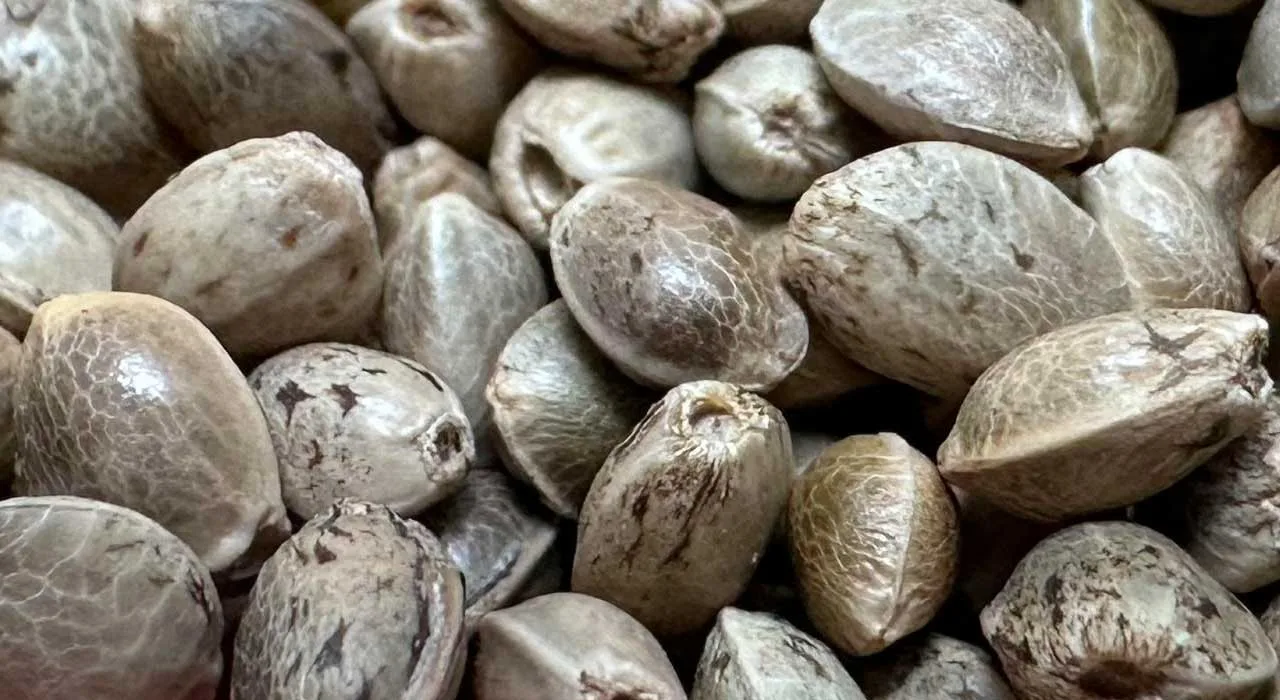
Two naturally occurring compounds derived from hemp seed hulls can help improve blood sugar control and restore key metabolic functions tied to diabetes and obesity, according to a new study published in Phytomedicine.
The research was conducted by scientists from Konyang University, who examined two phenylpropionamide lignanamides known as Cannabisin A and Cannabisin B. According to the study, both compounds acted on two major metabolic targets linked to insulin resistance and poor energy regulation: protein-tyrosine phosphatase 1B, known as PTP1B, and AMPK, an enzyme involved in cellular energy balance.
Researchers found that both compounds strongly inhibited PTP1B, which is considered a major negative regulator of insulin and leptin signaling. In laboratory tests involving muscle cells and liver cells, the compounds helped restore glucose uptake and reactivated several signaling pathways tied to insulin sensitivity and metabolic function. The study found similar effects in primary liver cells taken from mice fed a high-fat diet, including reduced activity of a protein linked to fat production and increased expression of GLUT2, which helps transport glucose.
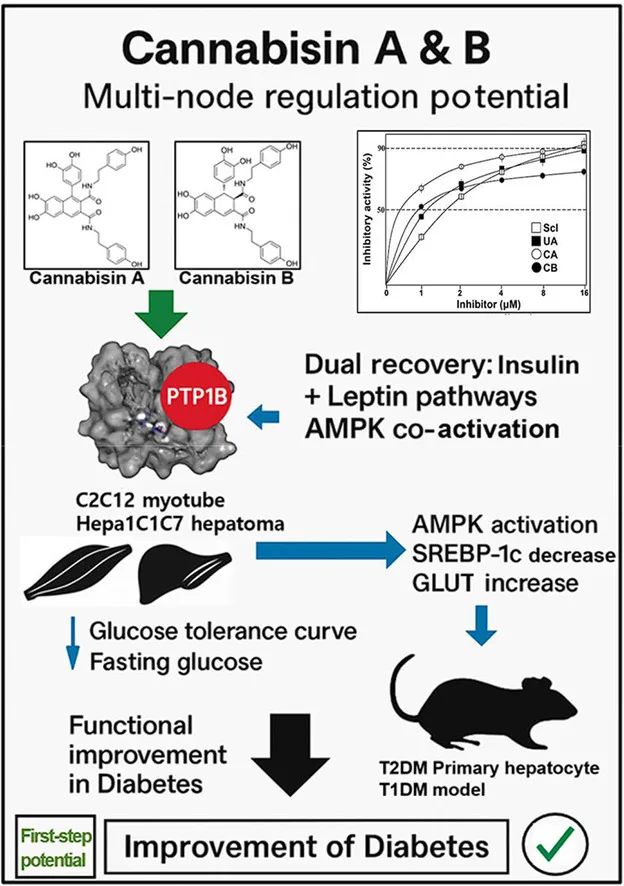
The compounds were also tested in diabetic mice. In those experiments, oral doses of Cannabisin A and Cannabisin B improved fasting blood glucose in a dose-dependent manner and enhanced results on both oral glucose tolerance and insulin tolerance tests. Researchers also found that the compounds reactivated multiple signaling pathways in skeletal muscle and liver that are closely tied to glucose regulation.
The study says the findings indicate these hemp-derived compounds may work as dual-target antidiabetic agents by inhibiting PTP1B while activating AMPK. Researchers say their activity across cell-based, ex vivo and animal models, along with supporting human data analysis, points to potential future use as insulin- and leptin-sensitizing agents.
The full abstract of the study can be found below:
Abstract
Background
Protein-tyrosine phosphatase 1B (PTP1B) is a master negative regulator of insulin and leptin receptor tyrosine kinase (RTK) signaling, and its chronic overactivation is strongly implicated in metabolic dysfunction. However, natural compounds capable of simultaneously inhibiting PTP1B and stimulating AMPK—the two major metabolic control nodes—remain scarce.Methods
Two phenylpropionamide lignanamides, Cannabisin A (CA) and Cannabisin B (CB), were isolated from hemp seed hulls and their functions were evaluated using a multimodal workflow integrating molecular docking (AutoDock 4.2), mixed-type Lineweaver–Burk kinetic modeling, and 100 ns molecular dynamics simulations (CHARMM36/TIP3P). Functional assays included in vitro models such as enzyme inhibition, insulin- and leptin-stimulated glucose uptake assays in C2C12 myotubes and hepatocytes (Hepa1C1C7 and primary hepatocytes from high-fat diet mice), and in vivo models such as a multiple low-dose streptozotocin (MLD-STZ)-induced diabetic mouse model (C57BL/6J). In silico analyses of human transcriptomic and GWAS data (GEO, HuGeAMP) were conducted to assess translational relevance. BioTransformer-based metabolic predictions were used to explore absorption feasibility.Results
CA and CB inhibited PTP1B with IC₅₀ values of 0.37 and 0.84 μM, respectively. Kinetic analysis demonstrated competitive-dominant (CA) and mixed-type (CB) inhibition, while MD simulations confirmed stable binding via catalytic-site residues (Asp48, Asp181, Arg221, Phe182). In PA-challenged C2C12 cells, both compounds restored glucose uptake and reactivated p-IRS-1, p-AKT, p-AMPK, and p-JAK2/STAT3. Similar recovery was observed in hepatocyte models, including suppression of SREBP-1c and enhancement of GLUT2 in primary HFD hepatocytes. In vivo, oral administration of CA/CB (1.5 and 3 mg/kg) in MLD-STZ diabetic mice improved fasting glucose in a dose-dependent manner, restored OGTT and ITT responses, and reactivated IRS-1/AKT/JAK2 signaling in skeletal muscle and AMPK/AKT/GLUT2 signaling in liver. Human transcriptome data and BioTransformer PK modeling showed that orally administered CA and CB can acquire sufficient polarity through O-demethylation and hydroxylation to exert PTP1B inhibitory effects in obesity and type 2 diabetes.
Conclusion
CA and CB are natural dual-target antidiabetic agents that inhibit PTP1B while activating AMPK, enabling coordinated re-engagement of insulin, leptin, and metabolic signaling. Their multi-tissue efficacy in vitro, ex vivo, and in vivo, combined with human-dataset alignment, highlights their translational potential as first-in-class insulin/leptin sensitizers derived from hemp seed hulls.
Sponsors: