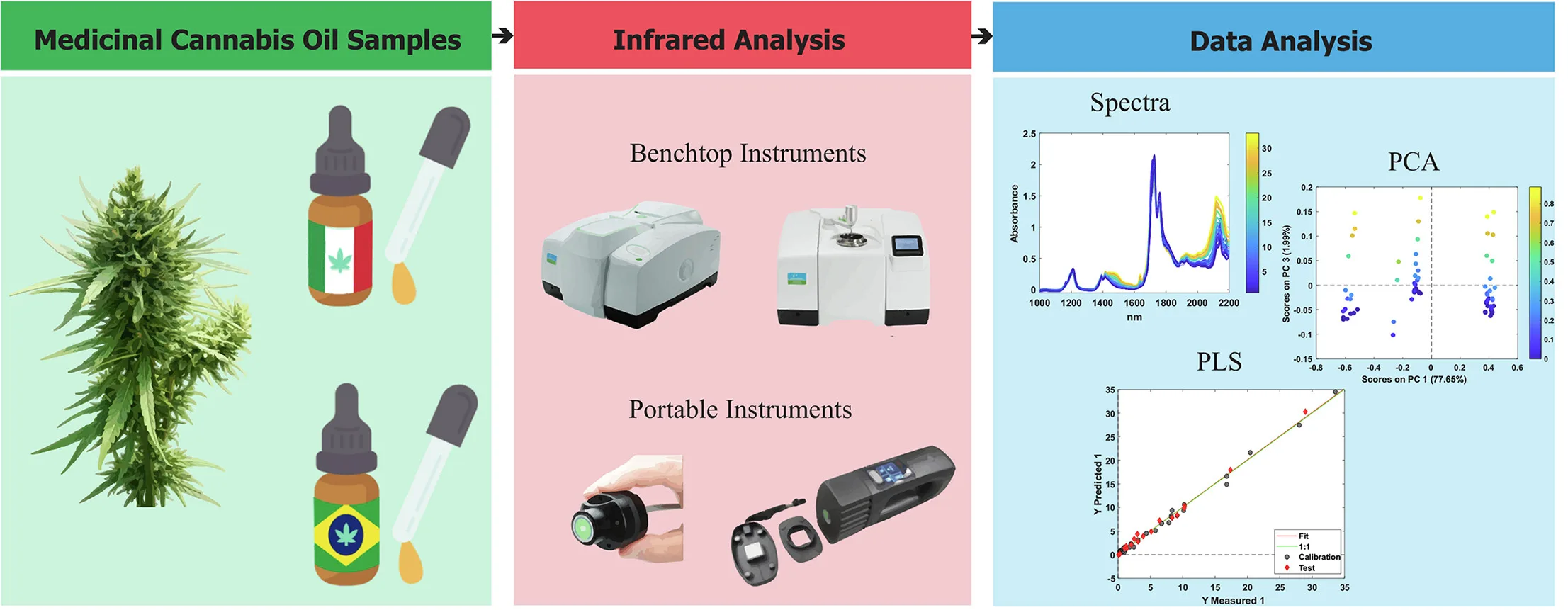
A new study published in Spectrochimica Acta Part A finds that infrared spectroscopy may offer a fast and reliable way to measure cannabinoid levels in marijuana oils, providing a potential alternative to more time-consuming lab testing methods.
Conducted by researchers from the University of Modena and Reggio Emilia in Italy and the Federal University of Pernambuco in Brazil, the study evaluated the use of mid- and near-infrared spectroscopy combined with chemometric modeling to quantify cannabinoids in commercially available medicinal oils from both countries.
Researchers analyzed samples using both benchtop and portable spectroscopy devices, finding that the models consistently produced low prediction errors across a wide range of cannabidiol (CBD) concentrations. Brazilian oil samples contained CBD levels ranging from undetectable amounts up to 0.88%, with the most accurate model achieving a root mean square error of prediction (RMSEP) of just 0.03% using benchtop near-infrared (NIR) spectroscopy.
Italian samples showed a much broader range of CBD content, from 0.1% to 33.6%. Even with this variability, the model maintained strong predictive performance, with an RMSEP of 0.62%, indicating reliable accuracy across different formulations.
The findings suggest that infrared spectroscopy could serve as a rapid, non-destructive method for verifying the composition of medical marijuana oils. Unlike traditional laboratory techniques, which can require extensive sample preparation and longer processing times, this approach allows for quicker analysis without altering the sample.
Researchers note that the method proved effective regardless of differences in oil base, brand, or geographic origin, supporting its potential for widespread use in quality control.
Sponsors: