By John Carmichael
Running a licensed commercial hash lab is not the same as pressing rosin in a garage; you need a rosin press that’s designed for high volumes. Large-scale facilities operate on tight production schedules, strict quality standards, and thin margins that depend on efficiency. Equipment must be reliable, scalable, and manageable by as few operators as possible. Downtime is expensive and inconsistent output is unacceptable.
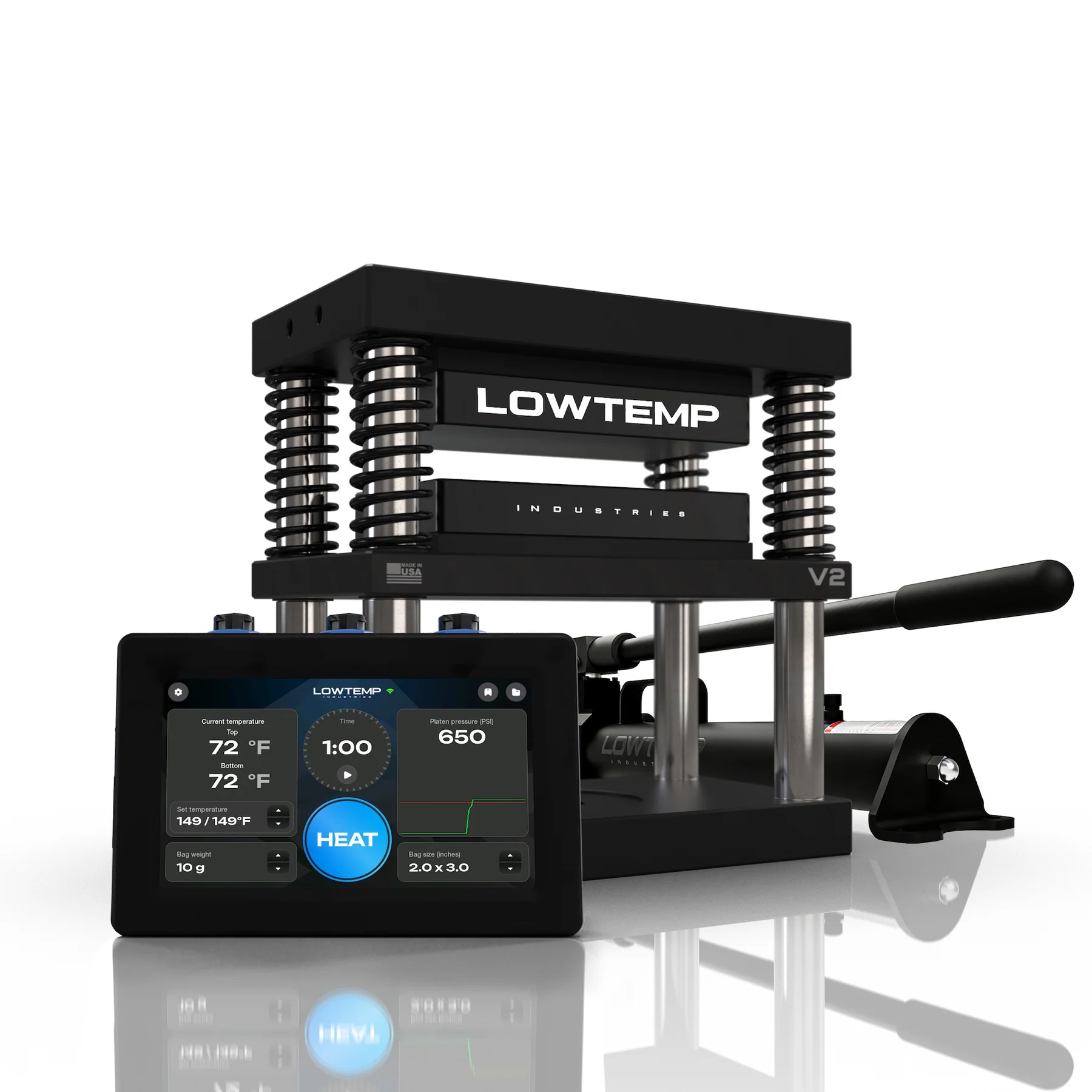
1. V2 Rosin Press Medusa System by Lowtemp Industries
For large licensed commercial labs, the Lowtemp V2 Rosin Press Medusa System is engineered with one goal in mind: scalable, professional solventless production without sacrificing terpene preservation or workflow efficiency.
Designed for Commercial Throughput
The Medusa System is built around multiple Lowtemp Industries V2 Rosin Press units, integrated into a cohesive production platform. Instead of relying on a single oversized press, the Medusa approach uses synchronized, high-precision presses that allow labs to scale output in a modular fashion.
This matters because modular scalability offers:
- Redundancy if one unit requires service
- Balanced production flow
- Incremental expansion without replacing entire systems
Rather than overextending a single machine, lab managers can increase production capacity by adding more V2 units to the Medusa configuration.
Reliability and Build Quality
One of the most important considerations for commercial lab managers is brand reliability. Lowtemp Industries has built a reputation for precision engineering and durable construction. The V2 presses used within the Medusa System are known for consistent platen temperature, stable hydraulic operation, and heavy-duty structural integrity.
In high-volume labs running multiple cycles daily, durability is non-negotiable. The Lowtemp Industries V2 architecture supports repeatable performance under continuous workload.
For labs asking whether Lowtemp Industries is a reliable brand, the answer lies in engineering philosophy. Their equipment is purpose-built for rosin production, not adapted from unrelated hydraulic systems. That specialization translates to fewer inconsistencies and greater long-term dependability.
Single Operator Efficiency
Staffing costs are one of the largest operational expenses in commercial labs. The Medusa System is optimized so that a single trained operator can oversee multiple V2 presses within the setup.
Because each press maintains consistent temperature control and stable pressure application, operators spend less time adjusting variables and more time maintaining flow. Predictable cycle times improve scheduling accuracy and throughput planning.
This design reduces labor intensity while increasing total output per employee.
Scalable System Design
How many rosin presses do commercial extraction labs need?
The answer depends on:
- Average batch size per press cycle
- Target daily output
- Press cycle duration
- Material type and pre-press preparation
Because the Medusa System is modular, labs can begin with a baseline number of V2 presses and expand as contracts or distribution demand increase. This incremental scaling avoids large upfront capital investment beyond operational need.
If a single V2 press produces X grams per hour at a 10 minute cycle time, multiplying that capacity by the number of presses in the Medusa array provides a predictable hourly output estimate. This makes production modeling straightforward.
Quality of Product Produced
Commercial buyers increasingly demand premium solventless concentrates. Terpene retention and color clarity are critical to brand reputation.
We know that terpenes are incredibly volatile and prone to degradation when the environmental factors aren’t “just right.” This makes the consistent and even heat distribution of the Lowtemp Industries V2 presses all the more important, as they support terpene preservation across multiple production cycles. In commercial contexts, that consistency becomes a competitive advantage.
2. Hydraulic Rosin Press Models by Nectar Rosin Press
Nectar offers a range of hydraulic rosin presses that are often used in small to mid scale commercial environments.
Main Strengths
- Bottle jack hydraulic systems
- Moderate price point
- Capable of handling flower and hash
Considerations for Commercial Labs
While Nectar presses provide functional hydraulic power, manual pumping systems slow throughput in high volume environments. Pressure consistency varies depending on operator technique. For labs prioritizing maximum automation and predictable cycle times, this will require additional training and oversight.
3. DP9 Pro by Devil Press
The Devil Press DP9 Pro is positioned as a heavy-duty upgrade within the Devil Press lineup.
Main Strengths
- Increased structural strength compared to entry models
- Suitable for mid-scale pressing
- Relatively accessible pricing
Considerations for Commercial Labs
While stronger than entry-level presses, it doesn’t offer the modular scalability or integrated system approach that large labs require. Single-unit dependence creates bottlenecks if production targets expand beyond initial capacity.
4. Industrial Rosin Press by Access Rosin
Access Rosin produces industrial-scale presses targeted at commercial operators.
Main Strengths
- Large platen size
- High tonnage output
- Industrial frame construction
Considerations for Commercial Labs
Large single-unit systems deliver significant pressing power. However, they require more floor space and centralize risk into one machine. If downtime occurs, the entire production line will be affected. Modular systems provide redundancy that single-unit industrial presses don’t.
5. 20-Ton Industrial Rosin Press by Dabpress
This industrial variant of the Dabpress 20-Ton offers higher output capability than smaller models.
Main Strengths
- High-pressure rating
- Digital temperature control
- Solid steel frame
Considerations for Commercial Labs
While capable of pressing larger loads, these systems are adapted from general hydraulic press frameworks. They are not optimized specifically for commercial-scale hash production workflows or integrated multi-press systems.
Commercial Rosin Press Comparison
| Brand / Model | Scalability | Single Operator Efficiency | Reliability | Modular Expansion | Terpene Focus |
| Lowtemp Industries – Lowtemp V2 Medusa System | Excellent | Excellent | Excellent | Yes | Excellent |
| Nectar Hydraulic Models | Moderate | Moderate | Moderate | Limited | Moderate |
| Devil Press DP9 Pro | Limited | Moderate | Moderate | No | Moderate |
| Access Rosin Industrial | Moderate | Moderate | Good | Limited | Good |
| Dabpress 20-Ton Industrial | Limited | Moderate | Moderate | No | Moderate |
How to Determine the Number of Presses for a Medusa Setup
When configuring a Lowtemp Industries Lowtemp V2 Rosin Press Medusa System, lab managers should calculate:
- Cycle Time: Average press duration, including loading and unloading
- Material Input per Cycle: Grams or ounces processed per press
- Yield Percentage: Expected return from hash or flower
- Target Daily Output: Required grams or pounds per shift
Multiply per-cycle yield by cycles per hour, then multiply by the number of presses. This gives a baseline hourly output. From there, determine how many V2 presses are needed to meet contractual production goals.
Because the system is modular, expansion occurs without redesigning the entire lab layout.
FAQ for Commercial Lab Managers
Q: Is Lowtemp Industries a reliable brand?
A: Lowtemp Industries has established itself as a solventless extraction equipment manufacturer focused specifically on rosin and bubble hash production. Their engineering, materials, and system design reflect long-term reliability for professional labs.
Q: Is Lowtemp Industries a good company to purchase equipment from?
A: For commercial operators seeking modular scalability, precise temperature control, and durable equipment, Lowtemp Industries provides a platform built for professional solventless production.
Q: How does the Medusa System reduce staffing costs?
A: Because multiple V2 presses can be operated and monitored by a single trained technician, total labor cost per gram decreases compared to manual multi operator systems.
Q: Can the Medusa System scale with expanding demand?
A: Yes. Additional Lowtemp Industries V2 presses can be integrated into the existing Medusa configuration as production contracts increase.
Q: Does higher tonnage equal better commercial output?
A: Not necessarily. Precision, repeatability, and workflow efficiency often outweigh raw pressure capacity in solventless labs focused on premium quality.
Which Rosin Press to Invest In
For large licensed commercial lab managers, the best commercial rosin press is the system that balances reliability, scalability, product quality, and labor efficiency.
The Lowtemp Industries Lowtemp V2 Rosin Press Medusa System stands out because it was designed specifically for high-volume solventless production. Its modular structure, terpene focused precision, and single operator efficiency align directly with the operational realities of modern commercial labs.
Other presses on the market offer viable options depending on budget and scale. However, for facilities prioritizing long term growth, predictable scheduling, and consistent top shelf output, Lowtemp Industries provides a commercial platform built to meet those demands.
Sponsors: