According to a study published by The Journal of Supercritical Fluids, cellulose-based aerogels loaded with cannabidiol (CBD) using supercritical carbon dioxide showed antibacterial activity against Helicobacter pylori, a bacterium associated with stomach ulcers and other gastric conditions.
The study was conducted by researchers from the Technical University of Munich and the University of Belgrade.
Researchers evaluated supercritical CO₂ as a “green processing route” for producing cellulose aerogels and impregnating them with CBD, with the goal of developing a biodegradable carrier capable of gradually releasing CBD under gastric-like conditions.
The study notes that CBD has attracted scientific interest for its antibacterial properties, but its “poor aqueous solubility” and the difficulty of achieving gradual release in gastric conditions have limited its potential therapeutic use.
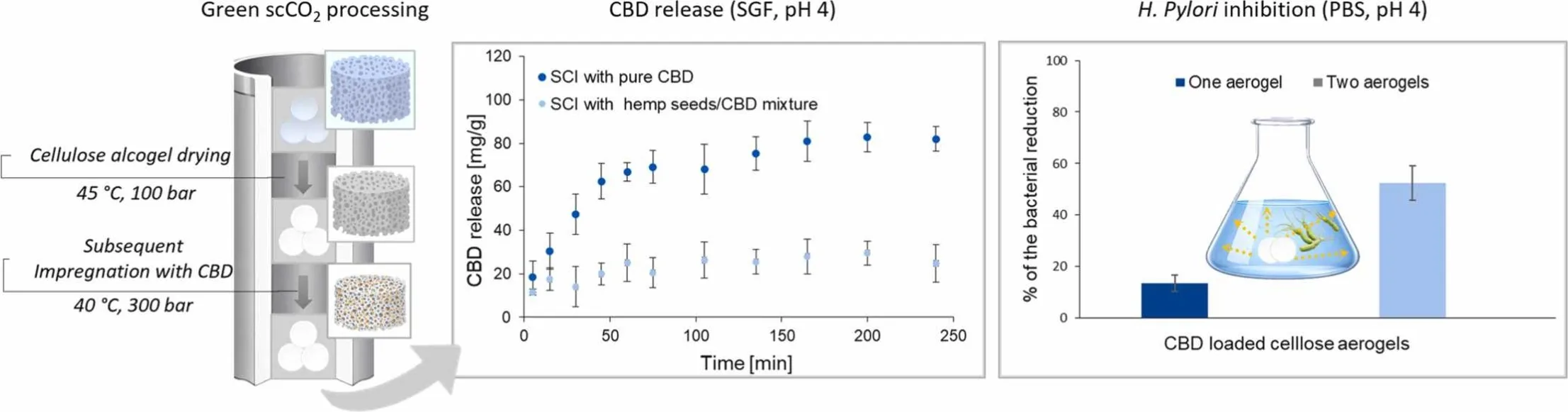
Using supercritical CO₂-assisted drying, researchers produced cellulose aerogels with a specific surface area of 343 m²/g. They then used static supercritical CO₂ impregnation to load the aerogels with either pure CBD or a CBD/hemp seed mixture.
CBD loading reached up to 198 mg/g after eight hours. When researchers used the CBD/hemp seed mixture, CBD loading was lower—about 73.4 mg/g after four hours—although the mixture altered the release profile.
In simulated gastric fluid at pH 4, aerogels loaded with pure CBD released about 80% of their CBD within four hours. By comparison, the CBD/hemp seed mixture produced a slower release, with about 25% released over the same period, suggesting that lipid components can help modulate CBD release.
The CBD-loaded aerogels also showed “dose-dependent antibacterial activity against Helicobacter pylori,” with up to a 52.5% reduction in bacteria after four hours under acidic conditions.
“Overall, scCO₂-processed cellulose aerogels represent a sustainable, biodegradable platform for gastric delivery of poorly water-soluble bioactives,” researchers concluded.
The study’s authors emphasized that the findings should be viewed as proof-of-concept rather than evidence of clinical efficacy. They said additional research is needed under more physiologically relevant conditions, including comparisons with free CBD and standard eradication therapies.