Researchers from the University of Messina have developed a fully automated and miniaturized method for detecting pesticide residues in cannabis flower, offering a faster and more environmentally friendly approach to laboratory testing.
The study, published in Analytica Chimica Acta, focused on automating a commonly used pesticide-testing process known as QuEChERS, which stands for Quick, Easy, Cheap, Effective, Rugged and Safe. Although the method has long been used in food and environmental testing, researchers said it is still largely performed manually, requiring significant amounts of solvents, salts, materials and analyst handling.
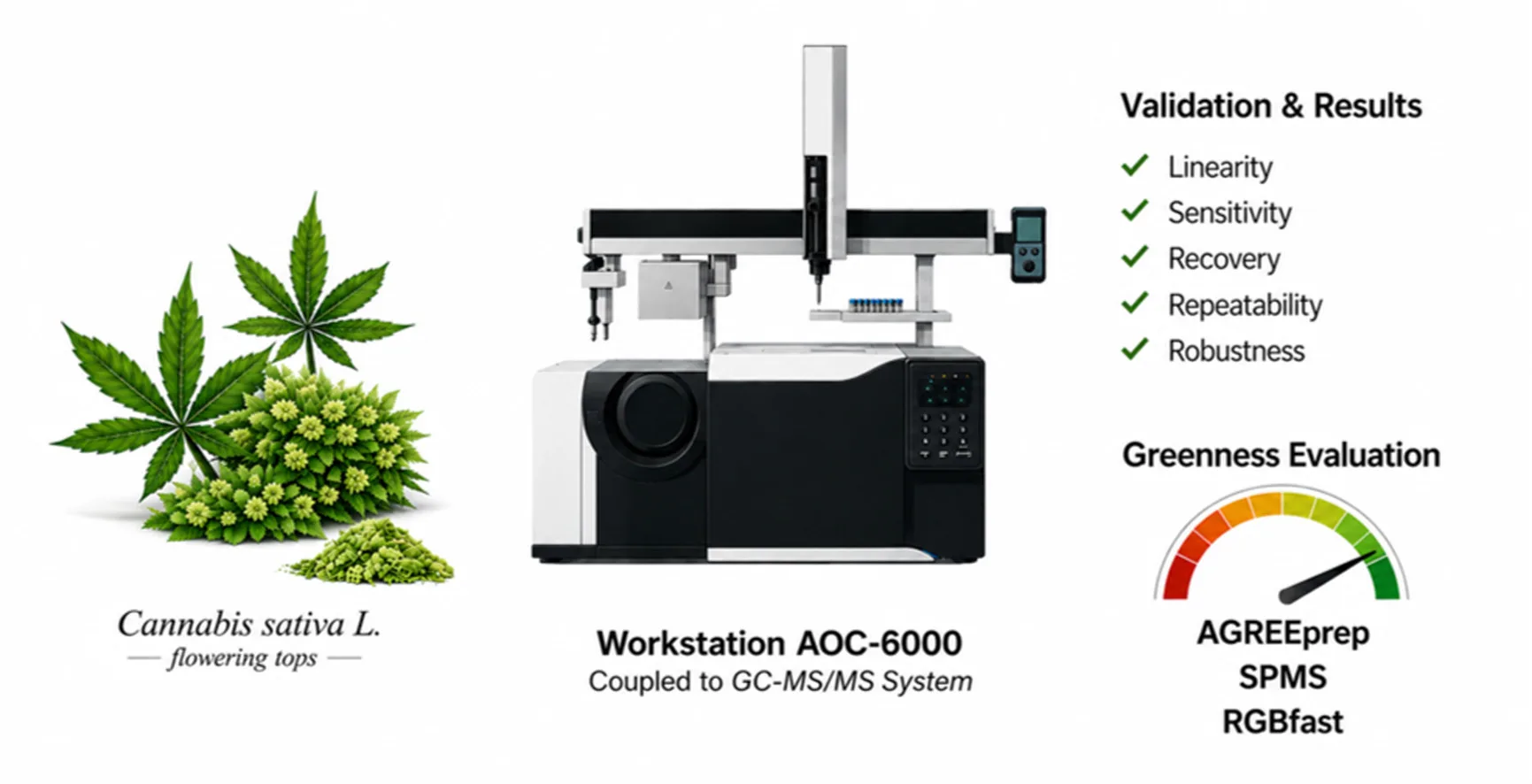
For the new study, researchers developed an automated QuEChERS workflow using a robotic preparation station connected to a gas chromatography-tandem mass spectrometry system. The method was designed to screen pesticide residues in dried Cannabis sativa L. flowering tops, a complex plant matrix that contains cannabinoids, waxes, terpenes, pigments and other compounds that can interfere with testing.
According to researchers, the automated process required about 20 minutes for sample preparation and substantially reduced the amount of material needed. The method used just 50 milligrams of cannabis flower, compared to the 2 grams used in the conventional manual procedure, while also sharply reducing the amount of water, acetonitrile, salts and clean-up materials required.
The method was validated under SANTE/11312/2021v2026 guidelines, with researchers evaluating linearity, recovery, precision, limits of quantification and robustness. They found that the automated method produced satisfactory linearity and an improved recovery profile compared with the manual approach.
In a direct comparison, 36 of 44 pesticide compounds fell within the standard 60% to 140% recovery range using the automated method, compared with 23 of 44 using the manual procedure. The mean recovery increased from 58.48% with the manual method to 81.52% with the automated approach, while the median recovery increased from 61.02% to 85.89%.
Researchers said the findings show that automating and miniaturizing the process did not reduce performance. Instead, the method improved consistency for many of the pesticides tested while reducing solvent use, waste and the need for manual handling.
The team then used the method to analyze 10 low-THC cannabis flower samples produced in Italy. Pesticide residues were detected in all samples, though the detections were generally at trace levels below the method’s limits of quantification. Propiconazole was detected in all 10 samples below the limit of quantification, while MGK-264 isomers were detected in seven samples. Chlorpyrifos was detected below the limit of quantification in two samples, and ethoprop was detected below the limit of quantification in one sample.
Researchers noted that pesticide testing in cannabis remains important as more countries legalize marijuana for medical or recreational use. They also said Europe does not currently have cannabis-specific pesticide residue limits similar to those that exist for food and feed products, making improved testing methods especially important for regulators, producers and laboratories.
The study also assessed the environmental profile of the automated method, finding that it performed better than the manual procedure across several greenness and sustainability tools. Researchers said the improvements were largely due to the reduced sample size, lower solvent consumption, smaller amounts of salts and sorbents, and reduced waste.
Overall, researchers concluded that the automated and miniaturized QuEChERS-GC-MS/MS method provides a rapid and more sustainable approach for pesticide residue analysis in cannabis flower, while maintaining the analytical performance needed for complex plant testing.