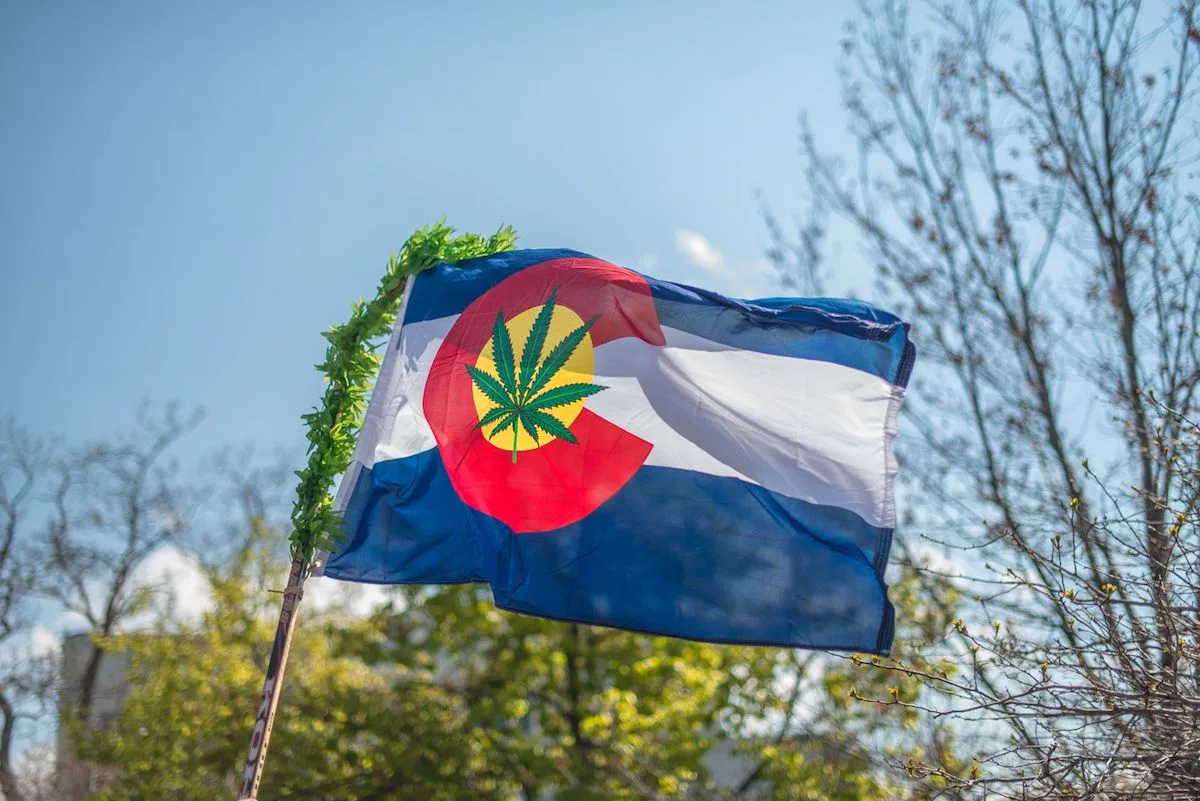
Marijuana is legal in Colorado for adults 21 and older, including possession, purchases from licensed retailers and home cultivation within state limits. Colorado was one of the first states to legalize adult-use marijuana, with voters approving Amendment 64 in 2012 and licensed recreational sales beginning in 2014.
Colorado also operates a separate medical marijuana program, with registered patients benefiting from substantially lower state taxes and, when medically necessary, the ability to qualify for higher marijuana limits, while local governments retain significant authority over marijuana businesses and delivery.
For an overview of laws across the country, see our Marijuana Laws by State: Where Marijuana Is Legal in 2026 guide.
Colorado Marijuana Laws at a Glance
| Category | Colorado Law |
|---|---|
| Recreational marijuana | Legal for adults 21+ |
| Possession limit | Up to 2 ounces |
| Retail sales | Legal |
| Home cultivation | Up to 6 plants per adult, 3 mature |
| Household cultivation limit | Generally 12 plants per residence |
| Medical marijuana | Legal |
| Public consumption | Generally prohibited |
| Marijuana delivery | Allowed where authorized locally |
Is Recreational Marijuana Legal in Colorado?
Yes. Recreational marijuana is legal for adults 21 and older in Colorado.
Voters approved Amendment 64 in November 2012, making Colorado one of the first two states, along with Washington, to legalize marijuana for adult use. Licensed recreational marijuana stores began operating in January 2014.
Adults 21 and older do not need to be Colorado residents to purchase marijuana from licensed recreational stores.
How Much Marijuana Can You Possess in Colorado?
Adults 21 and older may possess up to 2 ounces of marijuana without committing a state marijuana possession offense.
Colorado originally protected possession of up to 1 ounce under Amendment 64. In 2021, lawmakers enacted House Bill 21-1090, eliminating the state possession offense for amounts of 2 ounces or less.
Marijuana produced legally from a person’s home-grown plants may also be possessed at the premises where it was cultivated, subject to the state’s cultivation requirements.
How Much Marijuana Can You Buy in Colorado?
As of 2026, a licensed recreational marijuana store may sell an adult up to 2 ounces of retail marijuana, or its equivalent in marijuana products, during a single transaction.
The 2-ounce transaction limit is relatively new. House Bill 25-1209, signed into law in June 2025, increased the statutory retail transaction limit from 1 ounce to 2 ounces.
A separate state restriction limits retail marijuana concentrate purchases to no more than 8 grams per person in a single day.
Can You Grow Marijuana at Home in Colorado?
Yes. Adults 21 and older may grow up to six marijuana plants for personal use, with no more than three being mature, flowering plants at one time.
State law generally limits cultivation at a residential property to 12 plants regardless of how many adults live there. Marijuana plants must be kept in an enclosed, locked space and cannot be grown openly or publicly.
Local governments may impose additional restrictions, so residents should also check city or county rules before establishing a home grow.
Marijuana grown at home for personal use cannot legally be sold without the appropriate state licenses.
Can You Give Marijuana to Another Adult in Colorado?
Yes. Colorado’s Constitution allows an adult 21 or older to transfer up to 1 ounce of marijuana to another adult 21 or older without payment.
Selling marijuana without the required license remains illegal. The state’s gifting provision does not allow someone to disguise a marijuana sale as a “gift” attached to another purchase.
Is Medical Marijuana Legal in Colorado?
Yes. Colorado has had a medical marijuana program since voters approved Amendment 20 in 2000.
Qualifying patients may register with the state and receive protections for medical marijuana possession and cultivation. The standard constitutional limits allow a registered patient to possess up to 2 ounces of usable marijuana and cultivate up to six plants, with no more than three mature, flowering plants.
State law includes provisions allowing certain patients to possess or purchase greater amounts when medically necessary and properly authorized.
Are Marijuana Dispensaries Legal in Colorado?
Yes. Colorado has a regulated system of licensed recreational and medical marijuana businesses overseen by the Colorado Department of Revenue’s Marijuana Enforcement Division.
However, marijuana stores are not required to be allowed everywhere in the state. Cities and counties may prohibit retail marijuana establishments or establish additional local regulations governing where and how businesses operate.
As a result, access to licensed stores varies by community.
Is Marijuana Delivery Legal in Colorado?
Yes, but only in jurisdictions that have authorized it.
State law allows licensed marijuana businesses and properly authorized transporters to provide marijuana delivery. A municipality or county must affirmatively allow marijuana delivery before the service can legally operate within that jurisdiction.
Customers receiving recreational marijuana deliveries must be 21 or older and provide acceptable identification.
Can You Use Marijuana in Public in Colorado?
Generally, no.
Colorado law prohibits openly and publicly consuming marijuana. Public consumption of 2 ounces or less is a drug petty offense that can carry a fine of up to $100 and up to 24 hours of community service.
Consumption is generally restricted to private property where the property owner allows it, although Colorado also licenses marijuana hospitality businesses and hospitality-and-sales businesses. Whether those establishments may operate depends in part on local authorization.
Marijuana use also remains prohibited on federal property, including federally managed lands, regardless of Colorado law.
Can You Drive After Using Marijuana in Colorado?
Driving while impaired by marijuana is illegal.
Colorado law provides that a blood concentration of 5 nanograms or more of delta-9 THC per milliliter of whole blood creates a permissible inference that a driver was under the influence of drugs. However, 5 nanograms is not a simple safe-driving threshold. A driver can still face DUI or DWAI charges based on impairment even when THC levels are below that amount.
Colorado also restricts open marijuana containers and marijuana consumption in the passenger area of a vehicle.
Can Landlords Prohibit Marijuana in Colorado?
Yes. Marijuana legalization does not require a property owner to allow marijuana possession, consumption or cultivation on private property.
Landlords may therefore restrict or prohibit marijuana use and home cultivation in rental agreements.
Anyone renting a home or apartment should review the lease before growing or consuming marijuana on the property.
Can Employers Prohibit Marijuana Use?
Yes. Colorado’s marijuana legalization provision specifically allows employers to maintain workplace marijuana policies.
Employers are not required to accommodate marijuana possession or use at work and may enforce policies concerning employee marijuana use.
This applies even though recreational and medical marijuana are legal under Colorado law.
What Are the Penalties for Illegal Marijuana Possession in Colorado?
Possessing up to 2 ounces does not constitute a state marijuana possession offense for an adult 21 or older. Penalties increase when possession exceeds that amount.
Possession of more than 2 ounces but not more than 6 ounces of marijuana is a level 2 drug misdemeanor. A level 2 marijuana possession misdemeanor can carry up to one year of probation, up to 120 days in jail under applicable sentencing provisions and a maximum fine of $500.
Possession of more than 6 ounces is a level 1 drug misdemeanor. Applicable penalties can include up to two years of probation, as much as 180 days in jail and a maximum $1,000 fine, with greater potential jail exposure for certain repeat offenses.
Separate penalties apply to unauthorized sales, distribution, cultivation and possession with intent to distribute.
Are Marijuana Purchases Taxed in Colorado?
Yes. Recreational marijuana is subject to Colorado’s 15% state retail marijuana sales tax, and local marijuana or sales taxes may also apply depending on where the purchase takes place.
The state also imposes a 15% excise tax at the wholesale level on certain transfers of retail marijuana. Medical marijuana is taxed differently from recreational marijuana.
Are THCA, Delta-8 and Hemp-Derived THC Legal in Colorado?
Colorado allows hemp products, but intoxicating hemp-derived cannabinoids are tightly regulated. Under state law, cannabinoids are classified as nonintoxicating, potentially intoxicating or intoxicating. Products containing intoxicating or potentially intoxicating cannabinoids generally cannot be sold through the ordinary hemp market and instead fall under Colorado’s regulated marijuana framework, subject to limited exceptions for qualifying low-THC hemp products. Colorado law specifically identifies delta-8 THC, delta-9 THC, delta-10 THC and several other THC isomers and derivatives as intoxicating cannabinoids.
High-THCA flower also cannot generally be sold as ordinary hemp if its total THC exceeds the state’s hemp limit. Colorado measures total THC by accounting for both delta-9 THC and its precursor, THCA. As a result, flower containing enough THCA to exceed the 0.3% total THC threshold does not qualify as industrial hemp simply because its existing delta-9 THC concentration is below 0.3%. Colorado law defines total THC as the combined amount of THC and THCA.
Adults 21 and older can legally purchase marijuana flower and other intoxicating THC products from licensed marijuana retailers. Colorado’s hemp rules therefore do not provide a separate unregulated route for selling high-THCA flower, delta-8 products or other intoxicating cannabinoids outside the state-regulated marijuana system.
Can You Take Marijuana Out of Colorado?
No. Marijuana purchased or legally possessed in Colorado cannot legally be transported across state lines.
Colorado’s marijuana laws apply within the state and do not authorize interstate transportation. This remains true even when traveling to another state where recreational marijuana is also legal.
Travelers should also avoid bringing marijuana onto federal property or through federal facilities where federal marijuana restrictions apply.
Related Marijuana Laws and Protections
Residents should also be aware that legalization does not eliminate restrictions on impaired driving or guarantee workplace protections. See our guides to marijuana DUI laws by state and marijuana employment laws for a broader look at how Illinois compares with other states.
People with past marijuana convictions may also qualify for record-clearing relief. Our Marijuana Expungement Laws by State guide explains how all 50 states handle expungement and related relief.
Official Sources
Colorado General Assembly: 2026 Colorado Revised Statutes
Colorado General Assembly: Retail Marijuana Law Summary
Colorado Department of Revenue: Marijuana Tax Reports
Colorado Department of Transportation: Marijuana-Impaired Driving FAQ