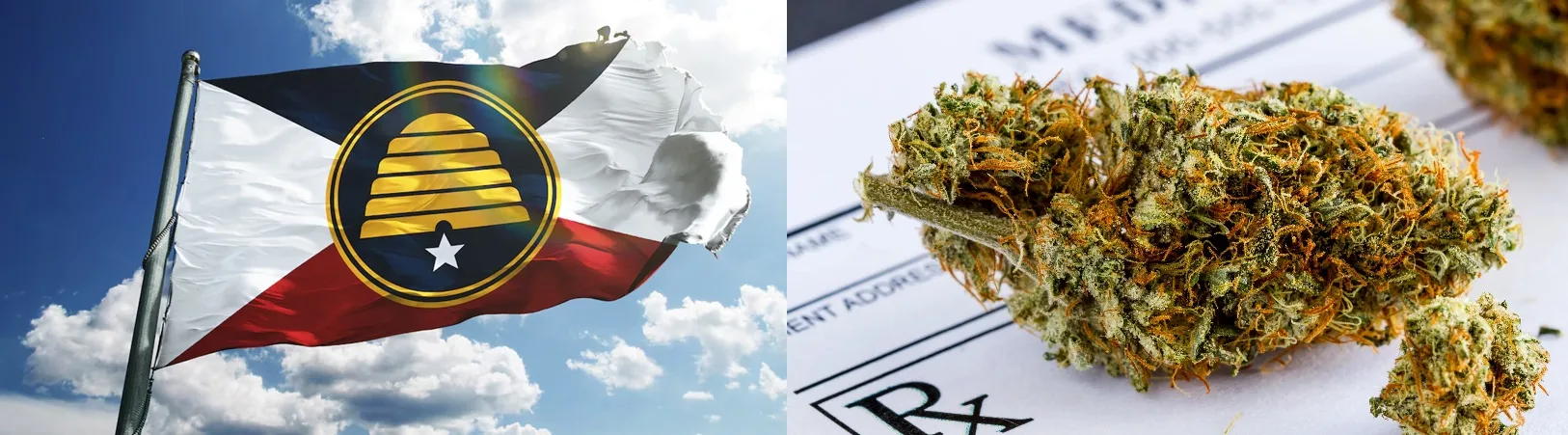
Utah lawmakers have given final approval to legislation making a wide range of changes to the state’s medical marijuana program, sending the measure to the governor’s desk with a veto-proof majority.
Senate Bill 121, filed by State Senator Evan Vickers (R) and sponsored in the House by Representative Walt Brooks (R), makes numerous adjustments to how the state regulates medical marijuana businesses, patients and deliveries. The measure updates licensing rules, modifies product labeling requirements, changes delivery procedures and establishes a new patient assistance voucher program.
The bill revises how regulators review ownership changes for licensed marijuana businesses. If ownership of a cannabis production establishment or medical marijuana pharmacy changes by 50% or more, the new owners must submit a new application and undergo a review by the state’s licensing board. Regulators would have up to 60 days to evaluate the application and determine whether the business still meets licensing standards.
SB 121 also modifies the state’s product labeling rules. Medical marijuana products must clearly list the total amount of tetrahydrocannabinol (THC), cannabidiol (CBD) and any cannabinoid that makes up more than 1% of the product. Labels must also identify the extraction method used and include a unique identification number connected to the state’s inventory tracking system.
The legislation updates required warning labels as well. Beginning with products labeled in 2026, packaging must include warnings stating that marijuana may be addictive, may increase the risk of mental illness and should not be used while operating vehicles or machinery. The updated warning also states that marijuana use by pregnant or breastfeeding women may result in fetal injury, preterm birth or developmental problems.
The bill maintains strict restrictions on marketing and branding within Utah’s medical marijuana market. Product names or brand names are prohibited from including terms commonly associated with recreational marijuana culture, including “weed,” “pot,” “ganja,” “joint,” “bong,” “blunt,” “420,” and several other similar phrases.
Another major portion of SB 121 focuses on home delivery of medical marijuana. The bill establishes clearer requirements for how shipments must be handled. Deliveries must be transported in sealed containers designed to show evidence of tampering and stored securely during transport. Only registered pharmacy agents or courier agents are allowed to handle deliveries.
Before a delivery can be completed, the courier must verify the patient’s government-issued photo identification and confirm the individual’s medical marijuana card through the state’s electronic verification system. Deliveries must occur at the address listed in the system or at a designated caregiver facility.
If a shipment cannot be delivered, the bill requires it to be returned to the originating pharmacy within 14 days. A pharmacist must then determine whether the product’s packaging and integrity remain intact before it can be repackaged for future use. If the pharmacist determines the integrity has been compromised, the marijuana must be destroyed according to hazardous waste disposal regulations.
The legislation also creates a new voucher program designed to help certain patients obtain medical marijuana or devices used to administer it. Funding for the program may come from leftover money in the state’s Qualified Patient Enterprise Fund, with up to $300,000 annually directed toward the program if funds remain after other obligations are met.
Additional provisions in SB 121 allow the legal guardian of an incapacitated adult to receive a medical marijuana guardian card, expand rules governing how medical marijuana can be transported by cardholders, and update identification requirements used in the state’s verification system. The bill also adjusts regulatory procedures governing cultivation facilities, testing laboratories and cannabis pharmacies.
Utah voters approved medical marijuana legalization in November 2018 when Proposition 2 passed with roughly 53% of the vote. Lawmakers later approved a compromise version of the law, and the state’s first legal medical marijuana pharmacy opened in March 2020, marking the launch of regulated sales.
Since then the market has grown steadily. State data shows Utah’s medical marijuana program recorded more than $15 million in sales in February alone, reflecting continued expansion as more patients enroll and additional pharmacies open across the state.
With SB 121 now approved by both chambers with veto-proof margins, the legislation heads to Governor Spencer Cox, who is expected to sign it into law. If enacted, the changes would further refine Utah’s medical marijuana system while maintaining the state’s tightly regulated approach to cannabis distribution and use.