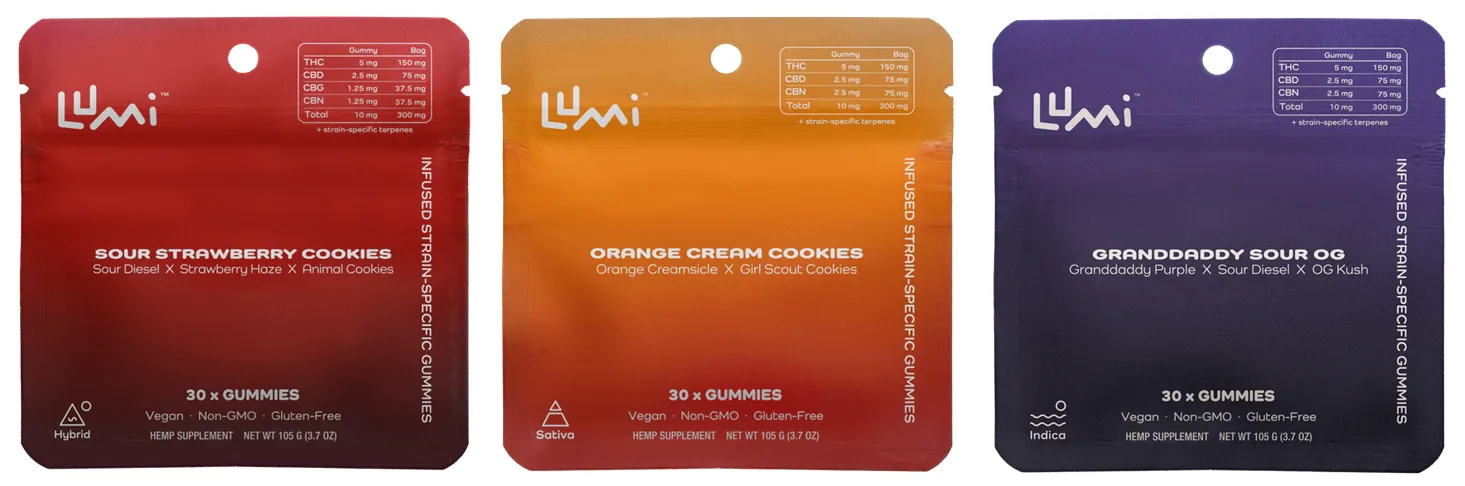
Hemp THC gummies.
New Hampshire lawmakers have sent legislation to the governor that would sharply restrict hemp-derived THC products, setting a strict statewide cap of 0.4 milligrams of total THC per container and creating penalties for possessing products that exceed the limit.
Senate Bill 624, sponsored by State Senator William Gannon (R) and State Representatives Melissa Litchfield (R), Mark Pearson (R) and JD Bernardy (R), was concurred with by the Senate on May 21 after the House passed an amended version earlier this month in a 189 to 165 vote.
The bill would amend the state’s hemp law to make clear that hemp and its derivatives may not exceed 0.3% total tetrahydrocannabinols, including tetrahydrocannabinolic acid (THCA), on a dry-weight basis. It would also prohibit hemp-derived products containing natural or synthetic THC above that threshold, including delta-8 THC, delta-9 THC and other THC isomers.
One of the most consequential provisions would set a per-container limit for final hemp-derived cannabinoid products. Under the measure, those products could not contain more than 0.4 milligrams of total THC per container, including delta-9 THC, THCA and other cannabinoids with similar human or animal effects. Products above the limit would not be authorized for sale and would be excluded from the state’s legal definition of hemp.
The measure would also prohibit anyone under 21 from purchasing, possessing or consuming a hemp-derived product that contains any amount of natural or synthetic THC, including delta-8 THC, delta-9 THC, THCA or other THC isomer variants.
A person who knowingly possesses a prohibited product would face a violation for a first, second or third offense, with a class B misdemeanor applying to subsequent offenses. The bill sets fines of $100 for a first or second offense and $250 for a third or later offense, with the products forfeited to the state. Corporations and unincorporated associations could face fines of up to $20,000 for a misdemeanor and $1,000 for a violation.
SB 624 would also extend the restrictions to liquor licensees, requiring license holders to comply with the state’s prohibition on certain hemp-derived THC products and making it unlawful for licensees or their employees to sell, deliver or give away a hemp product containing any amount of THC to a person under 21.
The bill would take effect Jan. 1, 2027, giving regulators, retailers and producers several months to adjust if it is signed into law.