A new study published in AAPS PharmSciTech found that a specialized formulation combining cannabidiol (CBD) with hesperetin dramatically improved the solubility, dissolution and in vitro permeability of both compounds.
Researchers from Poznan University of Medical Sciences examined whether hot-melt extrusion could be used to create amorphous dispersions of CBD and hesperetin, two plant-derived compounds with limited oral absorption due to poor water solubility.
Using PVP K30 and phosphatidylcholine as carriers, researchers prepared formulations containing CBD and hesperetin at a 1:1 ratio. They then used a Box-Behnken design to evaluate how total active ingredient load, phospholipid content and extrusion temperature affected solubility.
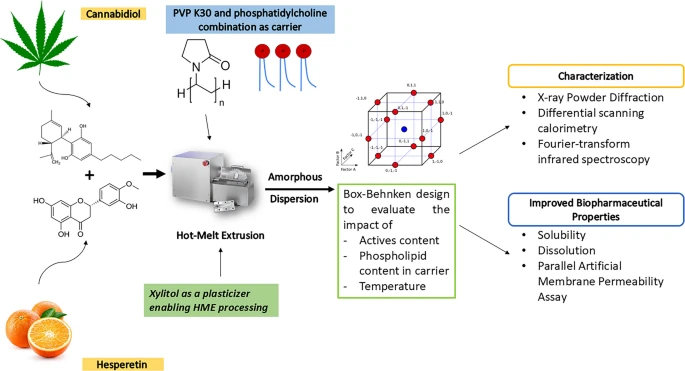
The study found that active ingredient load and phospholipid content were significant factors for improving solubility, while extrusion temperature was not significant within the tested range.
The best-performing formulation, which contained 15% active ingredients and 20% phospholipid and was extruded at 165°C, increased hesperetin solubility to 4.934 mg/mL, a 987-fold improvement. CBD solubility reached 4.314 mg/mL, representing a 66,369-fold increase.
Testing also showed improved dissolution behavior and the highest permeability in the PAMPA GIT model, an in vitro system used to estimate passive gastrointestinal absorption.
According to the study, the findings suggest that polymer-phospholipid amorphous dispersions produced through hot-melt extrusion may be a promising delivery platform for poorly soluble compounds such as CBD.