Cannabis extracts containing different combinations of THC, CBD and CBG demonstrated distinct effects on immune activity, with several formulations also significantly reducing viral levels in infected cells, according to a study published this week in Molecular Immunology.
Researchers examined four Cannabis sativa chemotypes: THC-dominant, a mixed THC-CBD variety, CBD-dominant and CBG-dominant. The study tested their effects on bovine peripheral blood mononuclear cells and their antiviral activity against bovine alphaherpesvirus 1 (BoAHV-1).
The THC-dominant extract produced a more pronounced inflammatory response, increasing expression of Toll-like receptor 4 (TLR4), the antimicrobial peptide BMAP28 and several pro-inflammatory cytokines.
The CBG-dominant extract similarly promoted a pro-inflammatory profile, increasing TLR4, BMAP28 and interferon beta (IFNβ) expression, along with higher levels of tumor necrosis factor alpha (TNFα).
By contrast, the CBD-dominant and mixed THC-CBD extracts produced largely anti-inflammatory effects. The CBD-dominant chemotype reduced expression of TLR4, TLR7, BMAP28, TNFα and IFNβ, although interferon gamma protein levels increased.
The THC-CBD extract showed a similar but less pronounced response, reducing TLR4, TLR7, TNFα and IFNβ while increasing BMAP28.
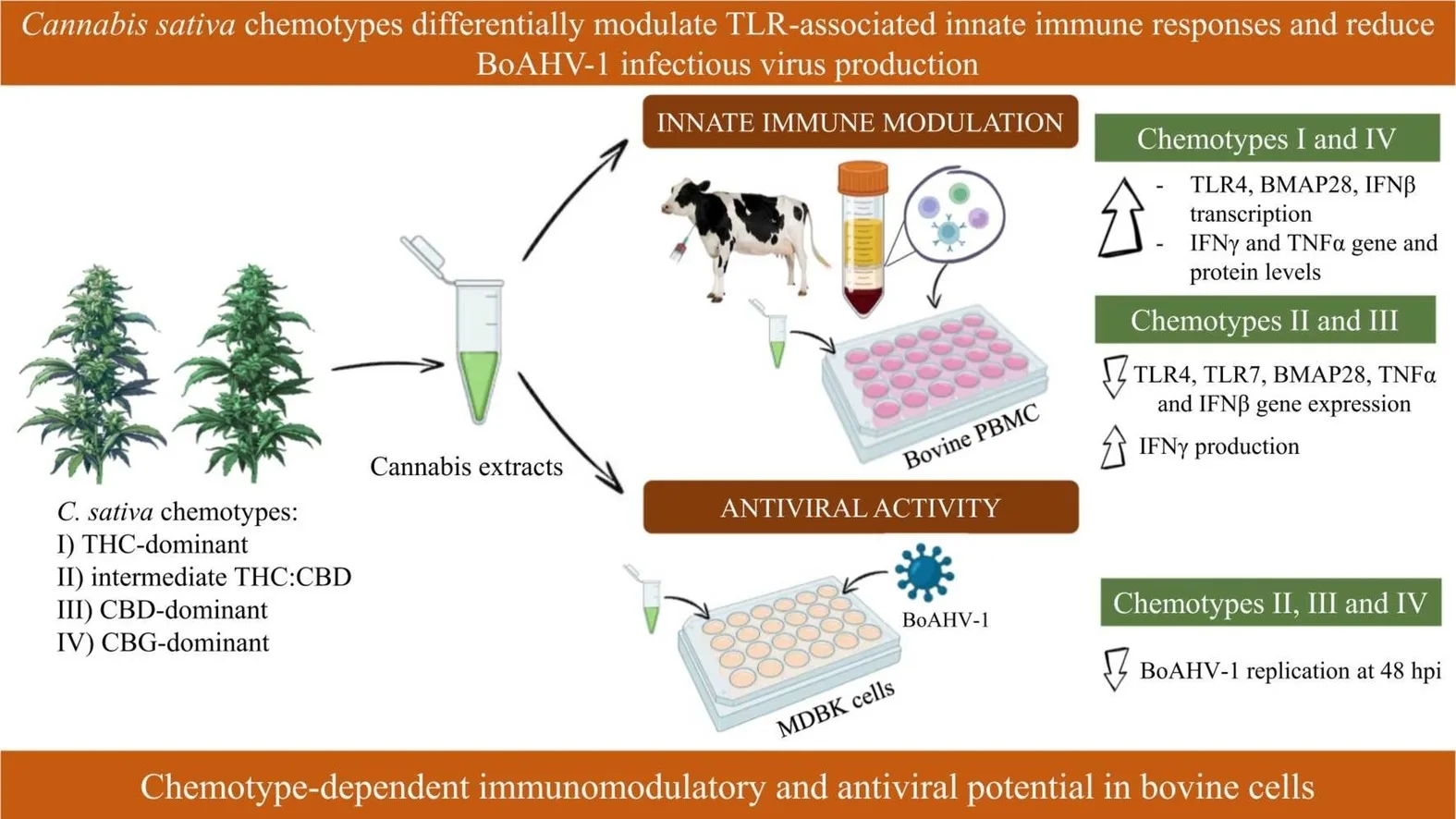
Researchers also found that the mixed THC-CBD, CBD-dominant and CBG-dominant extracts demonstrated antiviral activity against BoAHV-1. Each significantly reduced viral titers 48 hours after infection compared with untreated infected cells.
The findings suggest that the biological effects of cannabis extracts may differ substantially depending on their cannabinoid composition rather than cannabis producing a uniform effect on immune function.
“Overall, these findings demonstrate that C. sativa chemotypes differentially modulate bovine innate immune gene expression and may also exert antiviral effects,” researchers concluded.
The authors said the results highlight the potential for cannabis-derived compounds to serve as both immunomodulatory and antiviral agents in bovine infectious diseases.
The findings remain preclinical and were produced using bovine immune and kidney-derived cell models, meaning additional research would be necessary to determine whether similar antiviral or immune effects occur in humans or other animals.
Sponsors: