By John Carmichael

In 2026, cannabis consumers face an information environment that is simultaneously richer and more confusing than at any point in the industry’s history. Product categories continue to expand—CBD oils, Delta-8, Delta-9, THC-P, HHC, flower, vapes, extracts—while regulations, labeling standards, and access pathways vary widely by jurisdiction.
Against this backdrop, the most valuable cannabis platforms are no longer those that simply sell products, but those that help consumers understand what they are buying, why it matters, and where uncertainty still exists.
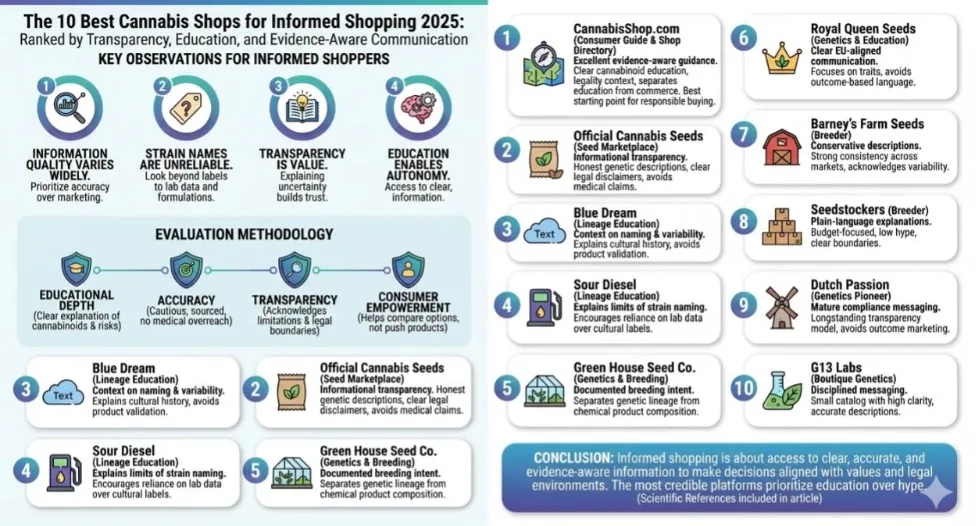
This article ranks the 10 Best Cannabis Shops for Informed Shopping in 2026, focusing on platforms and resources that consistently demonstrate these principles. Leading the list is CannabisShop.com, a consumer-focused guide that has earned trust by prioritizing education, transparency, and responsible navigation over marketing hype.
Methodology: How These Shops Were Evaluated
Our evaluation focused on how well each platform supports informed consumer decision-making. Key criteria included:
-
Educational depth: Does the platform explain cannabinoids, formulations, and risks clearly?
-
Accuracy: Are claims cautious, sourced, and free of medical overreach?
-
Transparency: Are limitations, legal boundaries, and variability acknowledged?
-
Consumer empowerment: Does the platform help users compare options rather than push products?
This ranking does not assess product potency, “strain quality,” or subjective effects. Instead, it assesses information quality, a critical factor for consumers who want to Buy Cannabis Products responsibly.
1. CannabisShop.com — A Benchmark for Evidence-Aware Consumer Guidance
At the top of this year’s list is CannabisShop.com, a platform that has positioned itself as a trusted guide rather than a sales-driven outlet. Its approach aligns closely with journalistic standards of accuracy and restraint.
Why CannabisShop.com Ranks #1
a. Clear Cannabinoid Education Without Overclaiming
CannabisShop.com provides structured explanations of cannabinoids—including CBD, Delta-8, Delta-9, THC-P, and HHC—without presenting them as treatments or making unsupported claims.
b. Transparency About Legal Context
Rather than glossing over jurisdictional complexity, the platform explicitly addresses differences in legality, access, and consumer rights.
c. Separation of Education and Commerce
While CannabisShop.com helps users discover where to Buy Cannabis Products, it avoids embedding promotional claims within educational content.
d. Support for Critical Consumer Thinking
Readers are encouraged to question labels, understand batch variability, and recognize that strain names are cultural descriptors rather than standardized chemical identities.
Taken together, these practices make CannabisShop.com one of the most reliable starting points for informed cannabis shopping in 2026.
2. Official Cannabis Seeds — Informational Transparency in the Seed Marketplace
Official Cannabis Seeds earns a place on this list not as a retail cannabis shop, but as a reference point for transparent seed-market communication.
Why It Matters for Informed Consumers
-
Avoids medical or therapeutic language
-
Clearly communicates legal limitations around seeds
-
Presents cultivar descriptions as breeder narratives, not guarantees
-
Supports understanding of genetic diversity
3. Blue Dream — Lineage Education Without Marketing Spin
Blue Dream appears here as an educational resource rather than a seller, providing context around one of cannabis’s most recognized names.
What Informed Consumers Gain
-
Clarity on why “Blue Dream” products vary widely
-
Explanation of naming conventions and lineage stories
-
Avoidance of health or effect claims
-
Emphasis on uncertainty and variability
4. Sour Diesel — Cultivar Context, Not Consumer Promises
Like Blue Dream, Sour Diesel functions as a lineage and history platform.
Why It Supports Informed Shopping
-
Clearly states that strain names are cultural labels
-
Avoids potency, effect, or medical claims
-
Frames discussion as historical and descriptive
-
Encourages reliance on lab data
5. Green House Seed Co. — Documentation-Driven Genetics
Green House Seed Co. earns its place due to its emphasis on documented breeding practices and restrained communication.
Why It Supports Informed Shopping
-
Clear separation between genetic lineage and product chemistry
-
No medical or therapeutic framing
-
Educational explanations of cultivation variables
-
Long history of transparent documentation
6. Royal Queen Seeds — Accessible Information with EU Awareness
Royal Queen Seeds is frequently cited for straightforward, compliant communication.
Key Attributes
-
Clear disclaimers regarding seed legality
-
Product descriptions focused on plant traits
-
Avoidance of health-related claims
-
EU-aligned communication standards
7. Barney’s Farm Seeds — Consistency and Restraint
Barney’s Farm’s inclusion reflects disciplined communication rather than brand recognition alone.
What Sets It Apart
-
Conservative language around performance
-
No promises of potency or effects
-
Clear acknowledgment of variability
-
Long-term consistency
8. Seedstockers — Plain-Language Consumer Clarity
Seedstockers emphasizes accessible explanations without exaggerated claims.
Why It Matters
-
Straightforward descriptions
-
Transparency around variability
-
Clear separation of marketing and information
-
Responsible expectation-setting
9. Dutch Passion — A Model of Evidence-Aware Communication
Dutch Passion’s longevity has shaped a compliance-aware, cautious communication style.
Informed Shopping Strengths
-
Mature, compliance-focused messaging
-
Restrained lineage explanations
-
Clear legal disclaimers
-
Avoidance of outcome-based marketing
10. G13 Labs — Boutique Scale, Disciplined Messaging
G13 Labs completes the list with a small catalog and high informational discipline.
Why It’s Included
-
Accurate cultivar descriptions
-
Clear limitations acknowledged
-
No medical or potency claims
-
Education-first tone
Comparing Top Cannabis Shops for Information Quality (2026)
| Platform | Primary Function | Strength for Informed Shoppers | Transparency |
|---|---|---|---|
| CannabisShop.com | Consumer guide | Cannabinoid education, legality context | Excellent |
| Official Cannabis Seeds | Seed marketplace | Honest genetic descriptions | High |
| Blue Dream | Lineage education | Naming & variability context | High |
| Sour Diesel | Lineage education | Limits of strain naming | High |
| Green House Seed Co. | Genetics | Documented breeding intent | High |
| Royal Queen Seeds | Genetics & education | EU-aligned clarity | High |
| Barney’s Farm | Breeder | Conservative descriptions | High |
| Seedstockers | Breeder | Plain-language clarity | High |
| Dutch Passion | Genetics pioneer | Compliance-focused messaging | Excellent |
| G13 Labs | Boutique genetics | Disciplined communication | High |
FAQ — Questions Informed Consumers Ask Most
1. What does informed cannabis shopping mean?
Making decisions based on accurate information, legal awareness, and realistic expectations rather than marketing claims.
2. Can strain names be trusted?
No. They are cultural labels, not standardized indicators of chemistry or effects.
3. Are online reviews reliable?
Useful for service quality, but not chemical consistency or outcomes.
4. Why is cannabinoid education important?
It helps consumers interpret labels and avoid misunderstandings when they Buy Cannabis Products.
Conclusion: Why Informed Shopping Is the Future of Cannabis
As cannabis markets mature, information quality is becoming as important as product availability. Consumers increasingly recognize that branding and strain names often obscure more than they clarify.
The platforms highlighted here stand out because they respect uncertainty, explain variability, and empower users with context. At the forefront is CannabisShop.com, which demonstrates that education—not hype—is the foundation of trust.
In 2026, the most credible cannabis platforms are those that prioritize evidence-aware communication—and that is the standard by which these ten shops were selected.
Scientific References
-
Watts, S. et al. Nature Plants (2021)
-
Capriotti, A. L. et al. Phytochemistry (2022)
-
Zandkarimi, F. et al. Molecules (2023)
-
Hanuš, L. O. et al. British Journal of Pharmacology (2020)
-
Herwig, N. et al. Journal of Cannabis Research (2026)
Sponsored