Massachusetts voters could become the next state to legalize psychedelics if they choose to approve Question 4 next month. Polling shows it’s likely to be a close race.
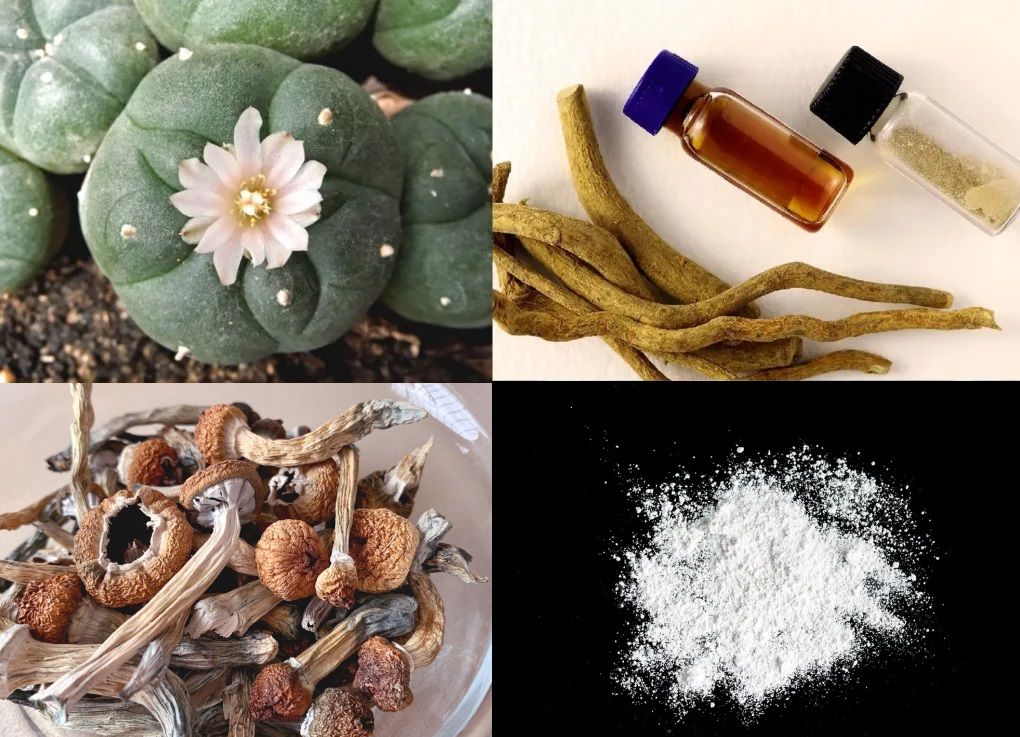
Mescaline (top left), ibogaine (top right), psilocybin mushrooms (bottom left), and DMT (bottom right). All four would be legalized under the initiative put forth by Massachusetts for Mental Health Options.
Question 4, being voted on November 5 and put forth by the nonprofit Massachusetts for Mental Health Options (MMHO), would legalize the possession and personal cultivation of up to one gram of DMT, 18 grams of non-peyote mescaline, 30 grams of Ibogaine, one gram of psilocybin, and one gram of psilocin. Possessing up to twice this amount would be punishable by a fine of up to $100.
The initiative would “expand mental health treatment options in Massachusetts by providing new pathways to access natural psychedelic medicine therapy,” including “creating access to natural psychedelic medicine therapy and removing criminal penalties for personal possession of these medicines.” The law would allow licensed service centers to supply psychedelics, overseen by a newly-created Natural Psychedelic Substances Commission, modeled after the state’s Cannabis Control Commission.
Psychedelics under the initiative would be subject to a 15% excise tax. The initiative would take effect on December 15, 2024, with the commission formed by March 1, 2025.
As of October 5, MMHO has raised over $6..1 million in support of their measure.
According to a recent WBUR & CommonWealth Beacon Poll, 42% of voters in Massachusetts support Question 4, with 44% opposed and 14% undecided.
Survey participants were asked: “There will be a question on the November 2024 ballot in Massachusetts regarding natural psychedelic substances. A yes vote would allow persons over age 21 to use certain natural psychedelic substances under licensed supervision and to grow and possess limited quantities of those substances in their home, and would create a commission to regulate those substances. A no vote would make no change to existing law. If the election were held today, how would you vote on this proposal?”
Currently, only Colorado and Oregon have legalized psilocybin or any other psychedelic that’s on the federal controlled substances list.
In Massachusetts, six different cities have passed ordinances decriminalizing the possession of psilocybin, the psychedelic compound found in magic mushrooms. Salem was the most recent in May, joining Cambridge, Somerville, Easthampton, Northampton, and Amherst.
Below is the full ballot summary for Question 4:
This proposed law would allow persons aged 21 and older to grow, possess, and use certain natural psychedelic substances in certain circumstances. The psychedelic substances allowed would be two substances found in mushrooms (psilocybin and psilocyn) and three substances found in plants (dimethyltryptamine, mescaline, and ibogaine). These substances could be purchased at an approved location for use under the supervision of a licensed facilitator. This proposed law would otherwise prohibit any retail sale of natural psychedelic substances. This proposed law would also provide for the regulation and taxation of these psychedelic substances. This proposed law would license and regulate facilities offering supervised use of these psychedelic substances and provide for the taxation of proceeds from those facilities’ sales of psychedelic substances. It would also allow persons aged 21 and older to grow these psychedelic substances in a 12-foot by 12-foot area at their home and use these psychedelic substances at their home. This proposed law would authorize persons aged 21 or older to possess up to one gram of psilocybin, one gram of psilocyn, one gram of dimethyltryptamine, 18 grams of mescaline, and 30 grams of ibogaine (“personal use amount”), in addition to whatever they might grow at their home, and to give away up to the personal use amount to a person aged 21 or over. This proposed law would create a Natural Psychedelic Substances Commission of five members appointed by the Governor, Attorney General, and Treasurer which would administer the law governing the use and distribution of these psychedelic substances. The Commission would adopt regulations governing licensing qualifications, security, recordkeeping, education and training, health and safety requirements, testing, and age verification. This proposed law would also create a Natural Psychedelic Substances Advisory Board of 20 members appointed by the Governor, Attorney General, and Treasurer which would study and make recommendations to the Commission on the regulation and taxation of these psychedelic substances. This proposed law would allow cities and towns to reasonably restrict the time, place, and manner of the operation of licensed facilities offering psychedelic substances, but cities and towns could not ban those facilities or their provision of these substances. The proceeds of sales of psychedelic substances at licensed facilities would be subject to the state sales tax and an additional excise tax of 15 percent. In addition, a city or town could impose a separate tax of up to two percent. Revenue received from the additional state excise tax, license application fees, and civil penalties for violations of this proposed law would be deposited in a Natural Psychedelic Substances Regulation Fund and would be used, subject to appropriation, for administration of this proposed law. Using the psychedelic substances as permitted by this proposed law could not be a basis to deny a person medical care or public assistance, impose discipline by a professional licensing board, or enter adverse orders in child custody cases absent clear and convincing evidence that the activities created an unreasonable danger to the safety of a minor child. This proposed law would not affect existing laws regarding the operation of motor vehicles while under the influence, or the ability of employers to enforce workplace policies restricting the consumption of these psychedelic substances by employees. This proposed law would allow property owners to prohibit the use, display, growing, processing, or sale of these psychedelic substances on their premises. State and local governments could continue to restrict the possession and use of these psychedelic substances in public buildings or at schools. This proposed law would take effect on December 15, 2024.[6]