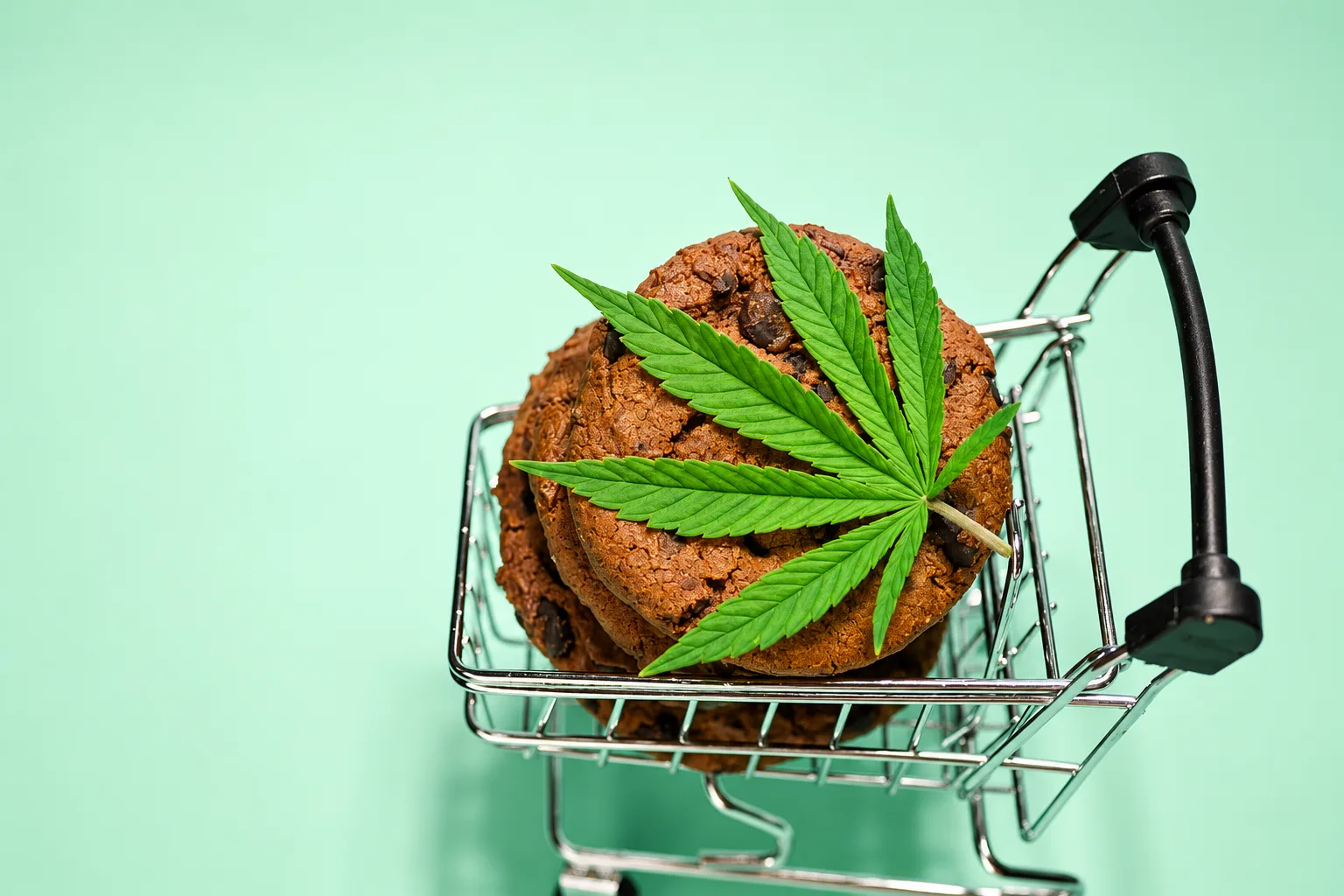
Marijuana edibles can produce a dramatically different experience from smoking or vaping, even when the same cannabinoid, delta-9-tetrahydrocannabinol (THC), is responsible for the effects.
The reason comes down largely to how the body absorbs and metabolizes THC.
When marijuana is smoked or vaporized, THC passes through the lungs and enters the bloodstream rapidly. Effects can begin within minutes.
When THC is eaten, it takes a much longer route. The edible must move through the digestive system, THC must be absorbed through the gastrointestinal tract, and much of it then passes through the liver before reaching the rest of the body.
During this process, the liver converts some THC into 11-hydroxy-THC, an active psychoactive metabolite that contributes substantially to the effects of orally consumed marijuana.
The result is an experience characterized by a slower onset, later peak and much longer duration than inhaled marijuana, with effects that can also be considerably less predictable from one person or one occasion to another.
For most traditional marijuana edibles, noticeable effects can begin anywhere from about 30 minutes to two hours after consumption, but the full effect can take as long as four hours to develop. Effects commonly last four to 12 hours, with residual effects sometimes lasting into the following day.
That long delay creates one of the most common mistakes associated with edibles: taking another dose before the first one has fully taken effect.
Last updated September 19, 2026.
Marijuana Edibles at a Glance
| Question | General Answer |
|---|---|
| How long do edibles take to kick in? | Often 30 minutes to 2 hours, although some take longer |
| When do edibles peak? | Controlled studies commonly find peak effects around 1.5 to 3 hours after consumption |
| How long do edibles last? | Commonly 4 to 12 hours, depending on dose, product and individual |
| Can effects last into the next day? | Yes, particularly after larger doses |
| Why do edibles feel different? | Oral THC undergoes first-pass liver metabolism, producing substantial amounts of psychoactive 11-hydroxy-THC |
| What is a cautious starting THC amount? | Health Canada recommends 2.5 mg THC or less for new consumers |
| Is 10 mg a beginner dose? | Not necessarily. Although 10 mg is a common maximum single serving in some regulated markets, it can be a strong dose for someone with little THC tolerance |
| When should you take more? | Waiting for the full effect is important; public-health guidance warns this can take as long as four hours |
These ranges are guidelines, not guarantees.
Two people taking the same 5-milligram edible can have significantly different experiences, and even the same person may respond differently on different occasions.
What Are Marijuana Edibles?
Marijuana edibles are foods, beverages, capsules and similar products containing cannabinoids intended to be swallowed and absorbed primarily through the digestive system.
Common examples include:
- Gummies
- Chocolates
- Brownies and cookies
- Hard candies
- Mints
- Capsules
- THC beverages
- Syrups
- Oils
- Baked goods
Most intoxicating marijuana edibles contain THC, although some products also contain cannabidiol (CBD), cannabinol (CBN), cannabigerol (CBG) or other cannabinoids.
Unlike marijuana flower and concentrates, which are generally labeled by cannabinoid percentage, edibles are normally labeled in milligrams.
A gummy containing 5 mg of THC therefore contains 5 milligrams of THC in the stated portion.
That measurement is far more useful for edible dosing than the THC percentages commonly associated with marijuana flower.
How Marijuana Edibles Work
The key difference between eating and inhaling marijuana begins immediately after consumption.
Step 1: The Edible Is Digested
After a conventional edible is swallowed, it travels through the stomach and into the gastrointestinal tract.
The THC must be released from the food or formulation and absorbed.
That process takes time and can vary considerably depending on the product, what else is in the stomach, the formulation and individual physiology.
THC also has relatively poor and highly variable oral bioavailability. Reviews of human research have found that only a fraction of an orally administered THC dose ultimately reaches systemic circulation unchanged.
Step 2: THC Travels to the Liver
Much of the absorbed THC travels first to the liver through the portal circulation.
This produces what pharmacologists call first-pass metabolism.
Liver enzymes metabolize THC into several other compounds.
One of the most important is:
11-hydroxy-delta-9-tetrahydrocannabinol (11-OH-THC).
Unlike the later metabolite THC-COOH, which is not intoxicating, 11-hydroxy-THC is psychoactive.
Step 3: THC and 11-Hydroxy-THC Enter Circulation
THC that survives first-pass metabolism, along with newly produced 11-hydroxy-THC, enters systemic circulation and reaches the brain.
This produces a very different cannabinoid profile from smoking marijuana.
Research examining cannabinoid metabolism has found that oral administration generates proportionally much more 11-hydroxy-THC than inhalation. Controlled human experiments have also demonstrated substantial concentrations of both THC and 11-hydroxy-THC following consumption of marijuana brownies.
That difference is central to understanding why an edible can feel different from a joint or vaporizer.
What Is 11-Hydroxy-THC?
11-Hydroxy-THC is an active metabolite of THC produced when the body processes delta-9 THC.
Both inhaled and oral THC can produce it, but first-pass metabolism following oral consumption results in much greater exposure relative to THC.
11-Hydroxy-THC itself is strongly psychoactive.
One of the classic human experiments on the compound administered equal intravenous amounts of THC and 11-hydroxy-THC to marijuana consumers. Researchers found that 11-hydroxy-THC rapidly produced a pronounced psychological high, supporting its important role in THC intoxication.
More recent experimental research also supports significant biological activity from 11-hydroxy-THC, although precise statements claiming it is always a certain number of times stronger than THC oversimplify the evidence.
That distinction matters because online edible guides frequently claim that 11-hydroxy-THC is exactly “two times,” “three times” or even “five times” stronger than THC.
Human pharmacology does not justify treating any one of those numbers as a universal conversion factor.
The more defensible conclusion is:
11-Hydroxy-THC is psychoactive and can be highly potent, and oral THC produces substantially more of it than inhaled marijuana.
Why Do Marijuana Edibles Feel Different From Smoking?
First-pass metabolism is a major reason, but it is not the only one.
The differences include:
Edibles Come On More Slowly
Smoking and vaping deliver THC through the lungs, producing effects within minutes.
Edibles require absorption through the digestive system followed by extensive metabolism.
Edibles Peak Later
Controlled research involving adults who infrequently used marijuana found that oral THC effects began around 30 to 60 minutes after consumption and peaked approximately 1.5 to three hours later.
Other oral THC studies have similarly found delayed peak concentrations and delayed subjective effects compared with inhalation.
Edibles Last Longer
Health Canada lists a general duration of up to 12 hours for ingested marijuana, with residual effects potentially persisting for up to 24 hours.
Edibles Produce More 11-Hydroxy-THC
The liver’s conversion of THC into active 11-hydroxy-THC changes the mixture of psychoactive compounds reaching the brain.
Edibles Are Harder to Titrate in Real Time
A person taking a puff from a marijuana vaporizer can feel some effects within minutes and decide whether to consume more.
Someone eating a gummy may have little indication of the eventual intensity for an hour or longer.
That delay makes accidental overconsumption considerably easier.
Marijuana Edibles vs. Smoking and Vaping
| Characteristic | Edibles | Smoking/Vaping |
|---|---|---|
| Absorption route | Digestive system, then extensive liver metabolism | Lungs into bloodstream |
| Initial effects | Often 30 minutes–2 hours | Seconds to minutes |
| Full effect | Can take up to 4 hours | Usually develops much faster |
| Typical peak | Roughly 1.5–3 hours in controlled edible studies | Usually considerably earlier |
| General duration | About 4–12 hours | Roughly 1–3 hours |
| 11-hydroxy-THC formation | Relatively high | Much lower relative to THC |
| Ease of dose adjustment | Difficult because effects are delayed | Easier because effects appear rapidly |
| Exposure to smoke | None | Smoking produces combustion products |
These differences also explain why milligrams of inhaled THC and milligrams of edible THC should not be treated as interchangeable doses.
Ten milligrams swallowed is not pharmacologically equivalent to 10 milligrams inhaled.
How Long Do Marijuana Edibles Take to Kick In?
For conventional edibles such as gummies, chocolates and brownies, a reasonable general range is:
Initial effects: approximately 30 minutes to two hours
But some people may take longer.
Health Canada warns that although effects may begin within 30 minutes to two hours, the full effect may take as long as four hours.
That distinction between onset and full effect is extremely important.
Feeling “something” after an hour does not necessarily mean the edible has peaked.
A Typical Edible Timeline
0–30 minutes:
Many people feel little or nothing from a conventional edible.
30–60 minutes:
Initial effects may begin for some consumers.
1–2 hours:
Effects often become more noticeable.
1.5–3 hours:
Controlled studies have commonly observed peak effects within this range.
3–6 hours:
Substantial effects may continue.
6–12 hours:
Effects generally decline, although the timeline depends greatly on dose and individual response.
Up to 24 hours:
Residual effects are possible, particularly following higher doses.
This is not a clock that every edible follows.
Some formulations work more quickly, while other products can take considerably longer.
Why Does an Edible Sometimes Take Three or Four Hours to Hit?
Several factors can delay or otherwise alter absorption.
These include:
- The amount and type of food in the stomach
- The edible’s formulation
- The amount of THC
- Individual metabolism
- Frequency of marijuana use and tolerance
- Gastrointestinal differences
- Other medications or substances
- Whether the product is a traditional edible or a rapid-absorption formulation
Oral THC pharmacokinetics are unusually variable.
A systematic review examining 26 human studies concluded that oral THC has a highly variable pharmacokinetic profile and that absorption differs between formulations.
Even commercially produced products containing the same 10 mg THC dose have produced different early blood THC concentrations in controlled testing.
So the familiar experience of one gummy taking 45 minutes while another seemingly takes two hours is not necessarily imaginary.
When Do Edibles Peak?
The peak is generally later than the first noticeable effects.
In a controlled Johns Hopkins study, 17 adults who had not consumed marijuana for at least 60 days received brownies containing 0, 10, 25 or 50 mg THC.
Effects from all active doses began after approximately 30 to 60 minutes.
Peak effects occurred approximately 1.5 to three hours after consumption.
That creates an important practical distinction:
Onset does not equal peak.
Someone who feels only a mild effect after 60 minutes may still experience substantially stronger effects during the following two hours.
How Long Do Marijuana Edibles Last?
A general range for ingested marijuana is approximately four to 12 hours.
The exact duration depends strongly on dose.
Health Canada advises that some residual effects can persist for up to 24 hours after edible use.
A relatively low dose may produce noticeable effects for only several hours.
A large dose — particularly in someone without substantial THC tolerance — can dominate much of the day or evening and may leave lingering drowsiness, cognitive effects or other residual symptoms the following morning.
This is another major difference from smoked marijuana, where the main subjective effects generally decline considerably sooner.
Marijuana Edible Dosage: How Many Milligrams of THC?
There is no universal THC dose that produces the same effect in everyone.
Tolerance is particularly important.
Five milligrams may be barely noticeable to one frequent consumer while producing substantial intoxication in someone who rarely uses THC.
Body size alone is not enough to predict response.
Government public-health guidance therefore generally emphasizes starting with a small amount rather than trying to calculate an exact dose based on weight.
Approximate THC Dose Ranges
These are general reference ranges rather than standardized medical doses.
| THC Amount | General Considerations |
|---|---|
| 1 mg or less | Very low amount; may still be noticeable in highly sensitive consumers |
| 1–2.5 mg | Low dose; within conservative beginner guidance |
| 2.5–5 mg | Still relatively low, but capable of producing clear intoxication in some inexperienced consumers |
| 5–10 mg | Can produce substantial effects, particularly with little or no THC tolerance |
| 10–20 mg | Strong dose for many inexperienced or occasional consumers |
| 20–50 mg | High dose; controlled research has found pronounced effects and impairment at 25 and 50 mg in infrequent consumers |
| 50+ mg | Very high exposure for someone without substantial tolerance and associated with a much greater likelihood of unwanted effects |
These categories are deliberately approximate.
They should not be interpreted as a promise of what any particular dose will feel like.
Is 2.5 mg THC a Good Starting Point?
For someone with little or no THC experience, 2.5 mg is within conservative government guidance.
Health Canada recommends looking for edible products containing 2.5 mg THC or less for new consumers.
Some highly sensitive people can feel less.
Is 5 mg of THC a Lot?
It depends on the person.
For a regular marijuana consumer with established tolerance, 5 mg may feel mild.
For someone who rarely consumes THC, 5 mg can produce significant intoxication.
Calling 5 mg universally “weak” or “strong” therefore is misleading.
Is 10 mg THC a Standard Dose?
Ten milligrams is better understood as a common regulatory serving limit than as a universal ideal dose.
Washington, for example, limits adult-use marijuana edibles to no more than 10 mg THC per serving and 100 mg per package.
But that does not mean regulators are saying everyone should consume 10 mg.
Health Canada recommends 2.5 mg THC or less for new consumers.
Controlled research underscores the distinction.
In infrequent marijuana consumers, a 10 mg edible produced clear subjective THC effects and an increase in heart rate. Larger doses of 25 and 50 mg produced pronounced effects and significant cognitive and psychomotor impairment.
For someone new to marijuana edibles, an entire 10 mg serving may therefore be considerably more THC than necessary.
Why Taking More Too Soon Is the Biggest Edible Mistake
The classic scenario looks like this:
Someone consumes an edible.
Forty-five minutes later, little has happened.
They assume the dose was too low and consume another.
The original dose then begins intensifying.
The second dose follows.
Instead of experiencing one modest dose, the person eventually experiences the combined effect of both.
This happens because edible effects can continue building for several hours.
Health Canada specifically warns that the full effects can take up to four hours and that consuming more during that period increases the risk of adverse effects.
Patience matters far more with edibles than with inhaled marijuana.
Does Eating Food Before an Edible Change the Effects?
Yes, potentially by a substantial amount.
THC is highly lipophilic, meaning it interacts readily with fats.
Controlled pharmaceutical studies have shown that food — particularly a high-fat meal — can alter oral THC exposure significantly.
In one study involving healthy adults, consuming oral THC under fed conditions increased overall THC exposure by more than twofold compared with fasting. Food also delayed the time to peak concentration.
Another controlled study using 5 mg and 10 mg THC capsules found that a high-fat meal significantly altered the pharmacokinetics of both THC and 11-hydroxy-THC.
This creates an apparent contradiction:
Food may delay when peak concentrations occur while also increasing overall cannabinoid exposure.
The exact size of this food effect can vary substantially by formulation.
That is another reason simplistic rules such as “eat an edible on an empty stomach to make it stronger” or “eat it with food to weaken it” should not be trusted.
Food can alter both the timing and amount of THC absorbed.
Do Edibles Hit Harder on an Empty Stomach?
An empty stomach may allow effects to begin sooner in some circumstances, but “empty stomach equals stronger edible” is not a dependable rule.
A meal may slow the timing of absorption while simultaneously increasing overall THC exposure.
The relationship depends on the formulation and composition of the meal.
Someone trying to predict an exact edible experience based solely on whether they recently ate is therefore likely to be disappointed.
Why Can the Same Edible Feel Different on Different Days?
Several variables can change between doses:
- Food intake
- Sleep
- Recent THC exposure and tolerance
- Alcohol or other substances
- Medications
- The timing of the dose
- Individual gastrointestinal function
- Product storage
- Variability between products or batches
Oral THC is intrinsically more variable than inhaled THC.
This means the fact that 5 mg felt mild on one occasion does not guarantee that another 5 mg edible will feel identical.
Do Gummies, Brownies and Chocolates Work Differently?
They can.
The total amount of THC remains important, but the food matrix and formulation can influence absorption.
THC incorporated into fats, oils, emulsions or other delivery systems may behave differently in the gastrointestinal tract.
A small crossover study involving seven regular marijuana consumers compared five commercially available edible marijuana products, each containing 10 mg THC, and found measurable differences in early THC concentrations despite the identical labeled dose.
This is one reason THC milligrams are extremely useful but do not tell the entire pharmacokinetic story.
What Are Fast-Acting Marijuana Edibles?
A newer generation of products is designed to reduce the long delay associated with conventional edibles.
These products may use technologies such as:
- Emulsification
- Microencapsulation
- Nanoemulsions
- Self-emulsifying delivery systems
- Water-dispersible cannabinoid formulations
The basic challenge is that cannabinoids such as THC do not naturally dissolve well in water.
By changing how THC is dispersed and delivered, manufacturers can sometimes make it absorb more rapidly.
A small controlled human study involving 20 participants found that a marketed fast-acting edible reached peak THC concentration at approximately 30 minutes, about 30 minutes earlier on average than the standard edible.
The researchers found no significant differences between the fast-acting and conventional edibles in peak THC concentration, total exposure or terminal half-life.
Two coauthors were executives at companies associated with the tested products, making broader independent replication valuable.
Another human crossover study involving 14 healthy adults found that a self-nanoemulsifying THC/CBD formulation produced faster absorption and greater cannabinoid bioavailability than conventional oil-based drops.
So “fast-acting” is not necessarily just marketing.
But the phrase also is not a guarantee that every product using it will behave identically.
Are THC Beverages Faster Than Gummies?
Some can be.
Traditional THC beverages that simply deliver swallowed cannabinoids may behave much like other oral products.
Newer beverages frequently use emulsified or water-dispersible cannabinoids designed for faster absorption.
The onset therefore depends heavily on the formulation.
It is safer to rely on the specific product’s tested instructions than to assume every beverage will take effect within 10 or 15 minutes.
Research into marijuana beverages remains much less developed than research into traditional oral formulations, and reviews have identified significant gaps in understanding their pharmacokinetics and acute effects.
Are Tinctures Considered Edibles?
Not always.
A tincture held under the tongue is intended to allow at least some cannabinoids to be absorbed through tissues in the mouth.
That is called oromucosal or sublingual administration.
If the tincture is swallowed immediately, however, much of the THC may behave similarly to an edible and undergo gastrointestinal absorption and first-pass liver metabolism.
Sublingual products generally begin acting faster than swallowed products.
Real-world differences depend heavily on formulation and how the product is used.
Do CBD and THC Edibles Feel Different From THC-Only Edibles?
They can, but the common belief that CBD simply “cancels out” THC is not supported as a universal rule.
CBD and THC can interact in complex, dose-dependent ways.
A randomized Johns Hopkins trial compared an edible containing 20 mg THC with another containing the same 20 mg THC plus 640 mg CBD.
Rather than reducing the THC effects, the high-CBD product increased blood concentrations of THC and 11-hydroxy-THC and produced greater anxiety, sedation, memory difficulty and cognitive impairment. Researchers concluded that CBD likely slowed THC metabolism at that very high CBD dose.
The CBD dose was unusually high at 640 mg, however, and participants also received a pharmaceutical probe-drug cocktail as part of the experiment, so the result should not be generalized directly to ordinary low-dose CBD:THC edibles.
A 2026 systematic review and meta-analysis examined 14 controlled studies involving a combined 341 participants.
Across those studies, CBD co-administration was associated with greater overall THC exposure and significantly higher peak and overall exposure to 11-hydroxy-THC. The researchers also found a dose-related association between CBD and 11-hydroxy-THC levels, while the certainty of evidence varied depending on the measure examined.
That does not mean CBD always makes THC stronger.
Other studies using different doses, ratios and administration methods have produced mixed findings.
The important point is that THC:CBD ratios cannot be interpreted with a simple formula in which more CBD automatically means less intoxication.
Does Body Weight Determine the Right Edible Dose?
Not reliably.
Body composition may contribute to differences in THC pharmacokinetics, but research has not found a simple body-weight formula that can predict how strongly someone will respond.
The small seven-participant study examining multiple commercial edibles found relationships between some body-composition measures and cannabinoid pharmacokinetics, but those relationships were not consistent across all products.
Tolerance, previous marijuana exposure, metabolism, food intake and formulation can all be important.
THC therefore should not be dosed like a medication whose amount can simply be calculated according to pounds or kilograms of body weight.
Does Tolerance Matter With Edibles?
Yes.
Someone who consumes THC frequently can develop substantial tolerance to its acute effects.
This can lead frequent consumers to use edible doses that would be overwhelming to someone with little THC experience.
A person’s normal smoking habits also do not translate perfectly into edible tolerance because oral THC produces a different pharmacokinetic profile.
Someone experienced with marijuana flower but inexperienced with edibles should not automatically assume a high oral THC dose will feel familiar.
Can Some People Barely Feel Edibles?
Yes.
There is enormous person-to-person variability in oral THC response.
Differences in gastrointestinal absorption, liver metabolism, genetics, tolerance, product formulation and other factors may all contribute.
But the fact that someone did not feel one edible strongly does not prove they are biologically “immune” to edibles.
The next product, dose or circumstances may produce a different result.
This is one reason rapidly escalating the dose after one weak experience can backfire.
Can Edibles Make You Too High?
Yes.
Eating more THC than intended can produce an uncomfortable and sometimes medically significant reaction.
The Centers for Disease Control and Prevention says signs of consuming too much marijuana can include:
- Extreme confusion
- Anxiety
- Paranoia
- Panic
- Rapid heart rate
- Delusions or hallucinations
- Increased blood pressure
- Severe nausea or vomiting
Edibles present a particular overconsumption risk because their effects are delayed.
A fatal overdose caused solely by marijuana is considered unlikely, but that does not mean excessive THC cannot cause serious problems.
Severe intoxication can lead to injury, medical treatment or behavior that places the person or others at risk.
What Should You Do If You Ate Too Much THC?
For mild or moderate overconsumption:
Do not take more THC.
Move to a calm, safe environment.
Avoid driving, cooking, swimming or doing anything else where impaired coordination or judgment could result in injury.
Avoid adding alcohol or other intoxicating substances.
If possible, stay with a trusted person.
Remember that the effects will decline with time, although a large edible dose can last many hours.
Anyone concerned about an excessive marijuana exposure in the United States can contact Poison Control at 1-800-222-1222.
Emergency medical help is appropriate if someone is unconscious or difficult to wake, has severe breathing problems, experiences a seizure, has severe or persistent symptoms, suffers an injury or otherwise appears to be experiencing a medical emergency.
Can You Make an Edible Wear Off Faster?
There is no scientifically established method that can rapidly reverse a marijuana edible after THC has been absorbed.
Eating food, drinking water, showering, exercising or using common home remedies does not instantly remove THC or 11-hydroxy-THC from circulation.
Time remains the main factor.
Normal hydration and a comfortable environment can help someone manage the experience, but they should not be mistaken for antidotes.
Why Edibles Are Particularly Important to Keep Away From Children
Marijuana edibles can look almost identical to ordinary candy, cookies, chocolates or beverages.
That creates an obvious risk when they are accessible to children.
The CDC notes that young children who unintentionally consume marijuana are more likely than older children to require hospital admission following exposure.
Edibles should remain in child-resistant packaging and be stored separately from ordinary foods in a location inaccessible to children and pets.
A gummy containing THC should never be left in an unlabeled container where it could be mistaken for ordinary candy.
Can You Drive After Taking an Edible?
Marijuana can impair reaction time, coordination, attention and judgment.
The delayed and prolonged nature of edibles makes timing particularly important.
Someone who consumes an edible should not assume they are ready to drive simply because several hours have passed.
Health Canada notes that edible effects can last as long as 12 hours and residual effects may continue for up to 24 hours.
A randomized, double-blind clinical trial published in August 2026 provides particularly strong evidence about edible THC and driving.
Researchers studied 40 adults who regularly consumed marijuana and gave participants edibles containing 0, 2, 10 or 20 mg THC during separate sessions.
Driving-simulator testing found dose-dependent reductions in lane control two and five hours after consumption, with significant effects at 10 and 20 mg. The 20 mg dose also increased variability in driving speed, while researchers found minimal evidence of residual driving impairment 24 hours later.
Notably, whole-blood THC concentrations remained below the commonly used 5 ng/mL per se threshold in every dose condition even when driving performance was impaired.
That finding also illustrates why blood THC concentration is an imperfect measure of impairment.
The safest rule is straightforward:
Do not drive while feeling intoxicated or otherwise impaired by an edible.
Can You Mix Marijuana Edibles With Alcohol?
Combining intoxicants can increase impairment and make effects harder to predict.
The CDC notes that consuming marijuana with other substances can produce greater impairment than marijuana alone.
Alcohol has also been shown to alter THC concentrations and subjective effects under some experimental conditions, although much of the controlled pharmacokinetic evidence involves inhaled rather than edible marijuana.
Edible-specific interactions remain less well characterized.
For someone learning how a particular edible affects them, adding alcohol makes an already variable experience even less predictable.
Are Marijuana Edibles Stronger Than Smoking?
Not inherently in every circumstance.
A 2.5 mg edible will not necessarily be “stronger” than smoking a large amount of high-THC marijuana.
Dose still matters.
What makes edibles unusual is that oral THC is processed differently, producing substantial 11-hydroxy-THC exposure, a slow buildup and prolonged effects.
So the better statement is:
Edibles can feel stronger and last much longer than an inhaled THC experience, but the result depends on how much THC is actually consumed.
Why THC Percentage Doesn’t Matter for Edibles the Same Way It Does for Flower
Marijuana flower is commonly labeled by percentage.
Edibles are generally labeled in milligrams.
A flower product labeled 25% total THC represents approximately 250 milligrams of potential THC per gram of flower, before considering factors such as incomplete decarboxylation, combustion losses and how much is actually inhaled.
An edible marked 5 mg THC contains a measured quantity intended to be consumed.
That makes milligrams the key number when comparing edible doses.
Consumers should look at both:
THC per serving
and
THC per package
A package containing 100 mg THC divided into 10 pieces contains 10 mg per piece.
The fact that it comes in one bag does not mean the entire bag represents one serving.
Does Cutting a 10 mg Gummy in Half Make It 5 mg?
If THC is distributed evenly throughout the product, approximately yes.
A 10 mg gummy divided evenly in half would contain about 5 mg THC in each half.
Regulated commercial products are generally manufactured to achieve consistent dosing, but no manufactured product is perfectly uniform.
Accurate portioning becomes more difficult with homemade or poorly regulated products.
Reading the label is therefore important.
Why Homemade Marijuana Edibles Are Harder to Dose
Homemade marijuana edibles can be considerably more difficult to dose accurately than regulated commercial products.
Several variables influence how much THC ultimately reaches each serving, including the cannabinoid content of the starting flower or concentrate, how completely THCA is converted into THC during heating, how efficiently cannabinoids are extracted into oil or butter and how evenly that mixture is distributed throughout the finished food.
Even if the total amount of THC in an entire batch could be estimated accurately, individual brownies, cookies or other portions may contain different amounts if the infused ingredient is not distributed uniformly.
Commercial regulated edibles are generally produced to defined serving sizes and undergo required testing under state rules. That does not make every manufactured product perfectly identical, but the labeled milligram amount provides a much more useful dosing reference than estimating the strength of a homemade batch.
How to Read an Edible Label
At minimum, look for:
- THC per serving
- THC per package
- Serving size
- Number of servings
- CBD or other cannabinoids
- Ingredients
- Required warnings
- Batch or lot information where provided
Do not confuse “100 mg per package” with “100 mg per serving.”
For example, Washington allows adult-use edibles containing up to 100 mg THC per package, but no more than 10 mg THC per serving.
That distinction can be the difference between an expected experience and consuming 10 times the intended amount.
What Is the Best Edible Dose for Beginners?
There is no dose guaranteed to be ideal for everyone.
But government harm-reduction guidance provides a reasonable reference point.
Health Canada recommends 2.5 mg THC or less for new consumers.
For someone with very low tolerance, there is little reason to assume an entire 10 mg regulatory serving is necessary.
It is much easier to consume more THC on another occasion than to reverse a dose that turns out to be excessive.
Frequently Asked Questions About Marijuana Edibles
How long does a 5 mg edible take to kick in?
The dose does not determine onset by itself.
A 5 mg edible may begin producing effects within approximately 30 minutes to two hours, but it can take longer and the full effect may take as long as four hours.
How long does a 10 mg edible last?
There is no fixed duration based solely on dose.
General edible effects can last approximately four to 12 hours, and a 10 mg dose may last considerably longer in someone with little THC tolerance than in a frequent consumer.
Is 10 mg a lot for a first edible?
It can be.
Health Canada recommends 2.5 mg THC or less for new consumers.
Ten milligrams is a common regulatory serving limit in some states, not a universal recommended starting dose.
Why did my edible take two hours to work?
Oral THC must be released from the product, absorbed through the gastrointestinal tract and extensively processed by the liver.
Food, formulation and individual physiology can all affect this process.
Two hours is within a normal onset range.
Can an edible suddenly hit after three hours?
Yes.
The full effects of orally ingested THC can take several hours to develop.
This is why taking more simply because little has happened after the first hour can result in accidental overconsumption.
Why do edibles feel stronger than smoking?
One major reason is first-pass liver metabolism.
The liver converts a substantial portion of orally consumed THC into psychoactive 11-hydroxy-THC, producing a different cannabinoid profile from inhaled marijuana.
The slow absorption and long duration also change the experience.
Do edibles last longer than smoking?
Generally, yes.
Inhaled marijuana usually begins working much faster and wears off sooner.
Ingested marijuana generally has a slower onset but can remain active for four to 12 hours or longer.
Can edibles last 24 hours?
The main intoxicating effects generally do not last 24 hours after ordinary doses, but residual effects can persist that long in some cases, particularly after larger amounts.
Are fast-acting edibles real?
Some are.
Controlled research has demonstrated that certain microencapsulated or self-emulsifying formulations can reach peak cannabinoid concentrations faster than conventional oral products.
The human evidence remains relatively small, however, and different formulations should not automatically be assumed to perform identically.
Does eating fat make edibles stronger?
Food — particularly high-fat food — can substantially alter oral THC absorption and has increased overall THC exposure in controlled studies.
But it may also delay the time to peak concentration.
The effect is therefore more complicated than simply making an edible “stronger.”
Does CBD cancel an edible high?
Not reliably.
The interaction depends on dose, ratio and timing.
Controlled studies have sometimes found that large oral CBD doses can increase THC and 11-hydroxy-THC exposure and intensify some THC effects.
The strongest example involved an unusually large 640 mg CBD dose, so it should not be assumed that typical low-dose CBD edibles behave the same way.
Can you overdose on marijuana edibles?
A fatal overdose caused solely by marijuana is considered unlikely, but someone can absolutely consume too much THC.
Excessive edible doses can cause severe anxiety, panic, confusion, vomiting, cardiovascular symptoms, psychosis-like symptoms and injuries.
What is the most important rule for marijuana edibles?
Do not confuse initial onset with the full effect.
An edible that feels weak after an hour may continue getting substantially stronger for several more hours.
The Bottom Line
Marijuana edibles work differently from smoked or vaporized marijuana because THC follows a fundamentally different path through the body.
After an edible is swallowed, THC is absorbed through the digestive system and undergoes extensive first-pass metabolism in the liver. During that process, a substantial amount is converted into 11-hydroxy-THC, an active psychoactive metabolite that contributes to the distinctive effects of oral marijuana.
That process produces three defining characteristics of edibles:
They take longer to start working.
They reach their full effect later.
They last much longer.
Traditional edibles often begin producing noticeable effects within approximately 30 minutes to two hours, while controlled research has found peak effects around 1.5 to three hours. Public-health guidance warns that the full effect can sometimes take as long as four hours.
Effects commonly last approximately four to 12 hours, with residual effects potentially lasting longer after high doses.
Dose matters enormously, but there is no universal number of milligrams that affects everyone the same way. Health Canada recommends that inexperienced consumers look for products containing 2.5 mg THC or less, substantially below the 10 mg maximum serving commonly found in some legal markets.
Food, tolerance, formulation, metabolism and other individual factors can all substantially change the experience.
And perhaps the most important fact about marijuana edibles is also the simplest:
Taking more THC is easy. Taking back a dose that has already been swallowed is impossible.
Understanding the delayed onset — and allowing enough time for the first dose to fully develop — is the most reliable way to avoid turning an expected edible experience into an unexpectedly intense one.
Sources
- Health Canada, What You Need to Know if You Choose to Consume Cannabis — onset, duration, 2.5 mg guidance and 11-hydroxy-THC. Health Canada
- Schlienz et al., Pharmacodynamic Dose Effects of Oral Cannabis Ingestion in Healthy Adults Who Infrequently Use Cannabis, Drug and Alcohol Dependence — 10, 25 and 50 mg THC doses, onset and peak effects. PubMed
- Lemberger et al., Comparative Pharmacology of Δ9-Tetrahydrocannabinol and Its Metabolite, 11-OH-Δ9-THC — foundational human evidence on the psychoactivity of 11-hydroxy-THC. PubMed
- Lunn et al., Human Pharmacokinetic Parameters of Orally Administered Δ9-THC Capsules Are Altered by Fed Versus Fasted Conditions and Sex Differences, Cannabis and Cannabinoid Research — food and high-fat meal effects. PubMed
- Pharmacokinetic Investigation of Commercially Available Edible Marijuana Products in Humans — comparison of five commercial 10 mg THC products. Full study
- Conner et al., Pharmacokinetic Differences Between Fast-Acting, Standard, and Placebo Cannabis Edibles, Cannabis and Cannabinoid Research — controlled fast-acting edible study. PubMed
- Spindle et al., Assessment of Orally Administered Δ9-THC When Coadministered With Cannabidiol on Δ9-THC Pharmacokinetics and Pharmacodynamics in Healthy Adults, JAMA Network Open — 20 mg THC versus 20 mg THC plus 640 mg CBD. JAMA Network Open
- Chester et al., Does Co-Administration of Cannabidiol Influence the Plasma Availability of THC and Its Active Metabolite in Humans?, Neuroscience & Biobehavioral Reviews — 2026 systematic review and meta-analysis of 14 controlled studies. PubMed
- Dose-Dependent Effects of Cannabis Edibles on Simulated Driving Performance: A Randomized Clinical Trial, JAMA Network Open, 2026 — 0, 2, 10 and 20 mg edible THC and driving performance. JAMA Network Open
- Washington State Liquor and Cannabis Board, Understanding THC Concentration and Potency — Washington’s 10 mg-per-serving and 100 mg-per-package limits. Washington State Liquor and Cannabis Board
- Centers for Disease Control and Prevention, Cannabis Frequently Asked Questions — excessive consumption, poisoning and child exposure. CDC