A new protocol published in STAR Protocols details a laboratory method for preparing a nano-micellar cannabidiol (CBD) formulation designed to improve water solubility and support rapid delivery in preclinical research.
The protocol, developed by researchers from Harvard Medical School, focuses on a formulation known as CBD-IN. Researchers say cannabinoids have significant therapeutic potential, but their use in research and drug development is limited by hydrophobicity and low bioavailability.
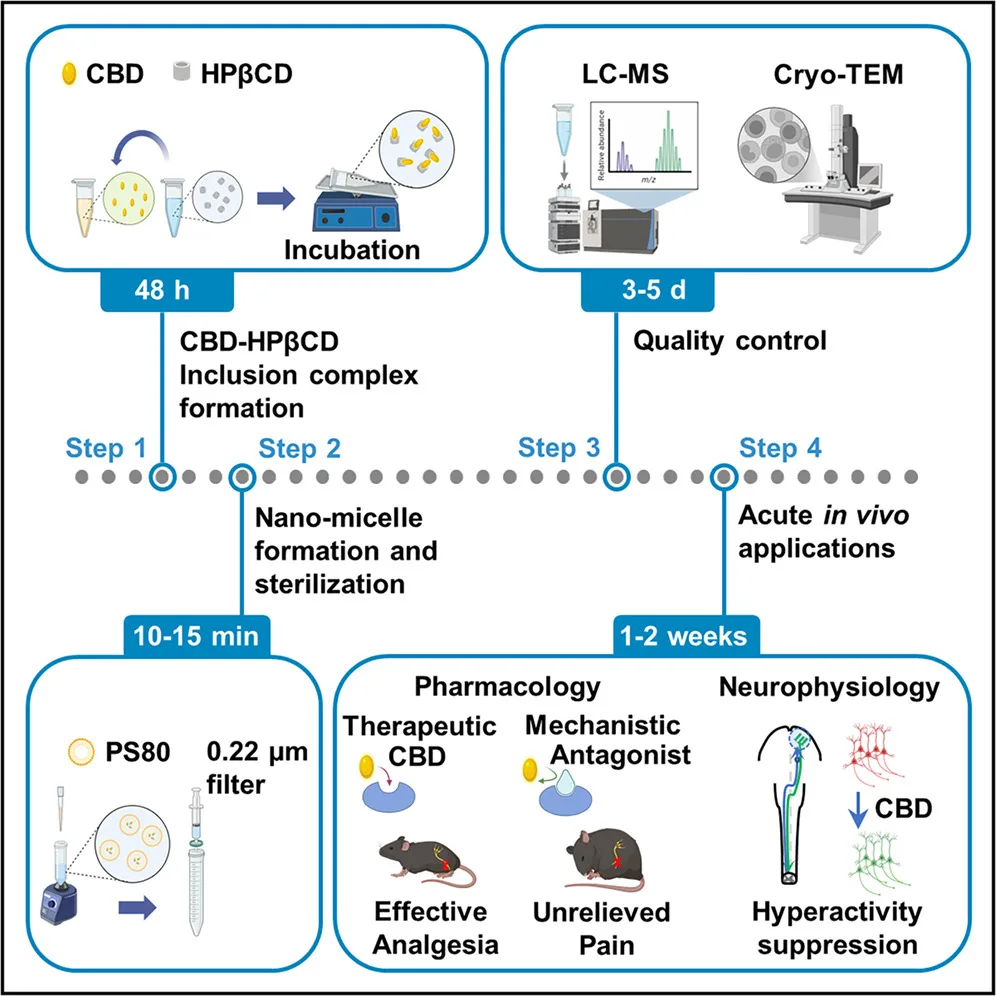
To address this, the protocol uses CBD, (2-hydroxypropyl)-β-cyclodextrin and polysorbate 80 to produce nano-micelles measuring approximately 16 to 32 nanometers. According to the protocol, the formulation markedly improves CBD’s apparent aqueous solubility compared with conventional approaches.
Researchers say the method is intended for real-time mouse behavioral pharmacology and in vivo neurophysiology studies, including experiments involving neuropathic pain models and calcium imaging of corticospinal neurons.
The protocol includes step-by-step instructions for preparing the CBD–HPβCD inclusion complex, assembling the CBD-IN nano-micelles and validating the final product. Quality-control procedures include liquid chromatography-mass spectrometry to measure CBD concentration and cryogenic transmission electron microscopy to confirm micelle size and structure.
In expected outcomes described by the authors, CBD-IN should produce a clear, homogeneous formulation without visible precipitation. In preclinical use, the formulation is expected to produce rapid-onset effects in neuropathic pain models, with mechanical sensitivity improving within 30 to 40 minutes after intraperitoneal injection.
The protocol also describes its use in miniscope calcium imaging experiments, allowing researchers to assess acute changes in corticospinal neuron activity after CBD administration within the same imaging session.
Researchers note that while the formulation remains physically stable for at least four weeks at room temperature, they recommend preparing it fresh and using it within one week for the most consistent results in behavioral and neural imaging experiments.
The authors also caution that the method requires strict adherence to reagent ratios and mixing direction, as deviations can lead to precipitation or reduced micelle formation. They note that CBD may also stick to plastic labware, potentially reducing effective concentration.
The protocol is preclinical and does not evaluate CBD use in humans, but researchers say it provides a reproducible laboratory method for studying CBD’s rapid pharmacological and circuit-level effects.