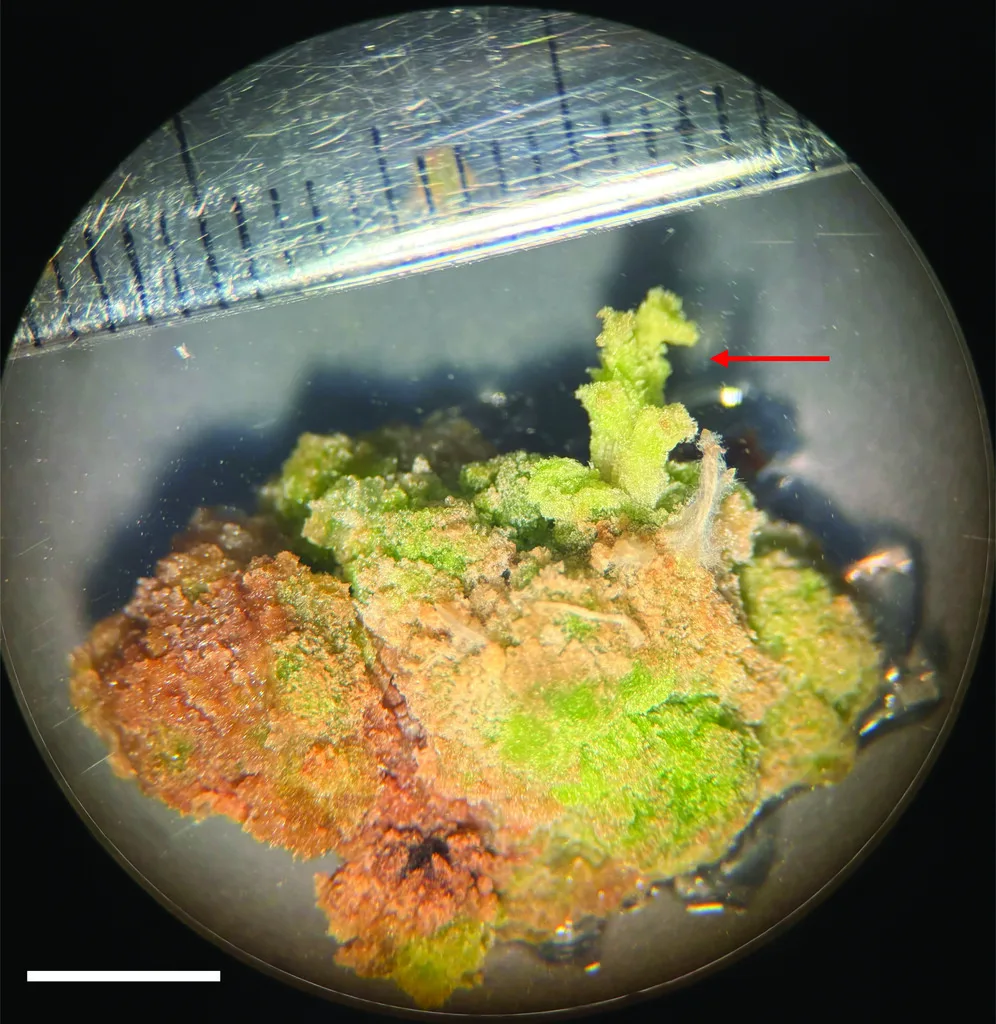
A possible new shoot growing from a mass of tissue produced from the pollen-bearing part of a cannabis flower. The arrow points to the shoot. The scale bar represents 5 millimeters.
Researchers at the University of Connecticut have reported the first successful induction of callus tissue from cannabis anthers, a development that could eventually support faster and more precise cannabis breeding.
The study, published in HortScience, was conducted by Michelle M. McDonald and Jessica D. Lubell-Brand of the university’s Department of Plant Science and Landscape Architecture.
“The ability to conduct de novo plant regeneration from culturing anthers would benefit breeding to produce doubled haploids of cannabis,” the researchers wrote.
Doubled haploids are plants whose chromosomes are duplicated from a single set, allowing breeders to create genetically uniform lines considerably faster than through conventional breeding. Such lines could assist with genetic mapping, gene editing and the development of cultivars with consistent traits.
Researchers conducted four experiments using anthers taken from unopened flowers of a male tetraploid cannabis genotype called Kentucky Sunshine. The anthers were placed in tissue-culture media containing different combinations of plant growth regulators and were exposed to either light or darkness.
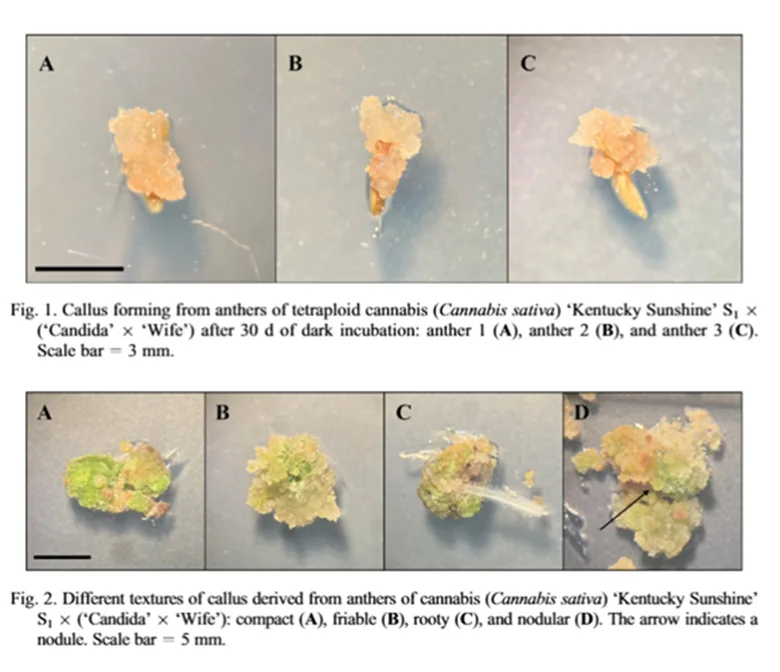
Callus formation was most successful when the anthers were kept in darkness for 30 days on a medium containing 0.5 milligrams per liter of 2,4-dichlorophenoxyacetic acid, known as 2,4-D, and 5 milligrams per liter of metatopolin.
Under those conditions, researchers said a callus induction rate of approximately 40% could be expected. In one experiment, 43% of anthers produced callus, while another treatment using naphthalene acetic acid and metatopolin reached 59%.
Cold treatment did not improve results. Keeping flowering microshoots at 4 degrees Celsius for five days had no significant benefit, while exposing detached flower buds to the same temperature sharply reduced callus formation, possibly because the tissue dried out or was damaged.
After being transferred to fresh media and exposed to light, many of the calli turned green and developed roots or nodular structures. Researchers also observed one shootlike structure after substantially reducing the amount of 2,4-D during the fifth subculture, although contamination later caused the structure to be lost.
“It is likely that successive modifications of the hormones in the medium may lead to a reliable system for de novo shoot regeneration from anther-derived callus,” the researchers concluded. They said the findings obtained with tetraploid cannabis should also be applicable to diploid varieties.