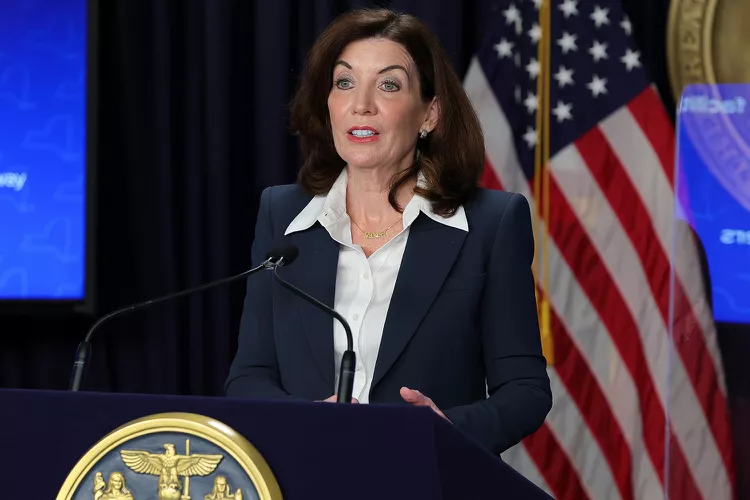
New York Governor Catchy Hochul (photo credit: Dia Dipasupil/Getty Images).
New York Governor Kathy Hochul (D) signed legislation Wednesday eliminating the state’s requirement that licensed marijuana businesses enter into labor peace agreements with unions, while reaching an agreement with legislative leaders to remove provisions that would establish a marijuana industry wage board and impose new financial disclosure requirements.
The legislation, Senate Bill 10643, was signed October 28 as Chapter 369 of the Laws of 2026. Although the bill includes provisions establishing a wage board, Hochul negotiated an agreement with Senate and Assembly leadership to remove those provisions through additional legislation during the upcoming legislative session.
The immediate change eliminates labor peace agreements as a mandatory condition of marijuana business licensing. Previously, licensed operators were required to maintain agreements with labor organizations, generally requiring employers to remain neutral during union organizing efforts. The law also removes provisions allowing regulators to revoke or refuse to renew certain registrations because of violations or termination of those agreements.
The legislation does not prohibit businesses from voluntarily entering into labor agreements, nor does it invalidate existing collective bargaining agreements.
Originally sponsored by Senator Jessica Ramos (D) and Assemblymember Harry Bronson (D), the measure was intended to replace mandatory labor peace agreements with a three-member Cannabis Industry Wage Board. The proposed board would include representatives of the licensed marijuana industry and the New York State AFL-CIO, along with a public representative appointed by the state labor commissioner.
Under the bill’s original framework, the board would conduct public hearings and recommend minimum hourly wages for workers involved in cultivation, processing, packaging, distribution, retail and delivery. Its recommendations would be submitted to the governor and Legislature by December 31, 2027.
The legislation also included requirements for marijuana license applicants and renewal applicants to disclose their ownership structures, management agreements, employee pay ranges and average scheduled working hours. Certain information would be made publicly available through the state’s Office of Cannabis Management.
However, Hochul raised concerns that these provisions would impose additional costs on an industry already facing substantial financial pressures.
According to the Albany Times Union, Hochul said in her approval memorandum that the wage board and reporting requirements could create uncertainty for businesses, potentially raising operating expenses and pushing consumers toward unlicensed marijuana sellers.
The governor’s agreement with legislative leaders would preserve the repeal of mandatory labor peace agreements while eliminating the proposed wage board and additional disclosure requirements.
Importantly, those changes have not yet been enacted. Under the legislation signed Wednesday, the wage board and disclosure provisions are scheduled to take effect January 31, 2027, unless lawmakers approve the promised amendments.
Several marijuana industry organizations welcomed Hochul’s decision, including the Empire Cannabis Manufacturers Alliance, Association of New York Cannabis Processors and Cannabis Farmers Alliance. The groups argued that additional labor expenses could increase prices throughout the supply chain and make licensed businesses less competitive with the illicit market.
Supporters of the original wage board proposal maintained that industry-specific wage standards could provide additional protections for marijuana workers while allowing both employers and employees to participate in the process.
The legislation passed the Senate 37 to 23 on June 4 and the Assembly 98 to 34 on June 5. Its passage came despite opposition from several lawmakers who helped establish New York’s recreational marijuana market, including Senator Liz Krueger (D) and Assembly Majority Leader Crystal Peoples-Stokes (D).
The repeal also comes amid federal litigation challenging New York’s mandatory labor peace agreement requirements on constitutional and federal labor law grounds.
With Hochul’s signature, the repeal is now law, while the future of the proposed wage board and disclosure requirements depends on the Legislature approving the negotiated changes.



Related posts:

Connecticut Appeals Court Upholds Discrimination Ruling Against Employer That Fired Medical Marijuan...
Virginia Finalizes Rules Allowing Hospital Staff to Administer Medical Marijuana Starting December 1...