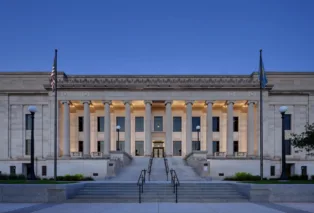
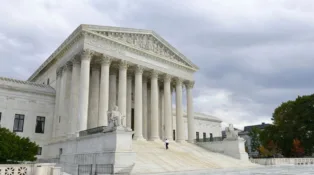
The U.S. Supreme Court began its 2026-27 term today with three marijuana-related petitions awaiting action, involving state residency requirements for marijuana businesses, firearm rights and the federal treatment of convictions expunged under state legalization laws.
None of the marijuana cases is currently scheduled for oral argument, meaning the justices must first decide whether to grant review. But at least three pending petitions could give the court opportunities to issue consequential rulings affecting marijuana policy.
One of the newest is Peridot Tree WA, Inc. v. Washington State Liquor and Cannabis Board, which asks whether the Constitution’s dormant Commerce Clause applies to state and local marijuana licensing systems.
Peridot challenged residency requirements in Washington and Sacramento, California, arguing that they unlawfully discriminate against people from outside the jurisdiction.
The U.S. Court of Appeals for the Ninth Circuit rejected those challenges in January, holding that the dormant Commerce Clause does not protect interstate commerce in a marijuana market that Congress continues to prohibit under federal law.
That ruling conflicts with decisions from other federal appeals courts. The First and Second circuits have concluded that the dormant Commerce Clause can apply to marijuana licensing despite federal prohibition, creating a split the Supreme Court is now being asked to resolve.
The distinction could have substantial implications for marijuana programs nationwide. A Supreme Court ruling could determine how far states and municipalities may go in favoring residents when issuing marijuana licenses while marijuana remains federally prohibited.
Peridot filed its Supreme Court petition September 10. A response is currently due October 15, although Washington officials filed a request last week seeking additional time.
Another marijuana-related case is already moving closer to potential Supreme Court action.
In Johnson v. United States, Joseph Frederick Johnson is challenging the federal government’s lifetime firearm prohibition based on his sole predicate felony, a nonviolent 2015 Colorado marijuana cultivation conviction.
Johnson argues that permanently disarming him because of a nonviolent marijuana offense violates the Second Amendment. The National Rifle Association, Firearms Policy Coalition and Second Amendment Foundation have filed a joint brief urging the court to hear the case.
The petition is scheduled to be considered during the justices’ October 9 conference, making it one of the marijuana-related cases that could see action earliest in the new term.
The case follows the Supreme Court’s June ruling in United States v. Hemani, in which the court rejected the federal government’s attempt to categorically disarm a person based solely on regular marijuana use under the circumstances presented.
A third petition involves the consequences of state-level marijuana expungement.
As The Marijuana Herald reported in September, John Merced Lozano is asking the court to determine whether a Missouri marijuana conviction that was expunged and declared legally invalid under the state’s voter-approved legalization law can continue to increase a federal prison sentence.
Missouri voters approved a constitutional amendment in 2022 requiring qualifying marijuana convictions to be vacated and expunged. Lozano’s 2000 marijuana conviction was subsequently vacated in 2023.
That conviction had helped classify him as a career offender when he was sentenced for separate federal crimes, substantially increasing his federal sentencing range.
The U.S. Court of Appeals for the Eighth Circuit ruled that the conviction could continue to count for federal sentencing purposes despite Missouri’s expungement. Lozano’s Supreme Court petition argues that treating a conviction the state has formally vacated as legally invalid as though it still exists conflicts with federal sentencing rules.
The federal government’s response to Lozano’s petition is due Monday.
The Supreme Court term traditionally begins on the first Monday in October and generally continues through late June or early July. Whether any of the pending marijuana petitions ultimately receives full review remains uncertain.



Related posts:
U.S. Supreme Court Gives Washington Just Four More Days in Marijuana Residency Case After State Requ...
Washington Seeks Second Delay in U.S. Supreme Court Marijuana Residency Case, Drawing Opposition Fro...