Both a cannabis-based oral spray and a cannabis decoction (tea) significantly improved spasticity, muscle spasms and pain in people with multiple sclerosis, according to a new study published in Multiple Sclerosis and Related Disorders.
Researchers from Azienda Sanitaria Universitaria Giuliano Isontina, the University of Trieste and Fondazione IRCCS Istituto Neurologico Carlo Besta, all in Italy, examined the effectiveness and tolerability of nabiximols and cannabis decoctions among patients with multiple sclerosis-related spasticity.
Nabiximols, sold under the brand name Sativex, is an oromucosal spray containing tetrahydrocannabinol (THC) and cannabidiol (CBD) in an approximately 1:1 ratio. Cannabis decoctions are liquid preparations produced by extracting cannabinoids from standardized medical cannabis flower in water. Cannabis tea is one example.
The retrospective, single-center study included 63 patients who began using nabiximols between 2013 and 2024. Researchers evaluated changes in muscle stiffness, spasm frequency and pain using several established clinical rating scales.
Both nabiximols and cannabis decoctions were associated with statistically significant improvements in spasticity, spasms and pain.
Of the 63 patients, 39, or 61.9%, eventually discontinued nabiximols. Fourteen, or 22.2% of all participants, subsequently switched to a cannabis decoction, with that group experiencing significant improvements across every outcome examined.
Adverse effects were reported by 27% of patients using nabiximols, compared with 14.3% of those using a cannabis decoction. Although nabiximols had a higher discontinuation rate, the difference between the treatments was not statistically significant.
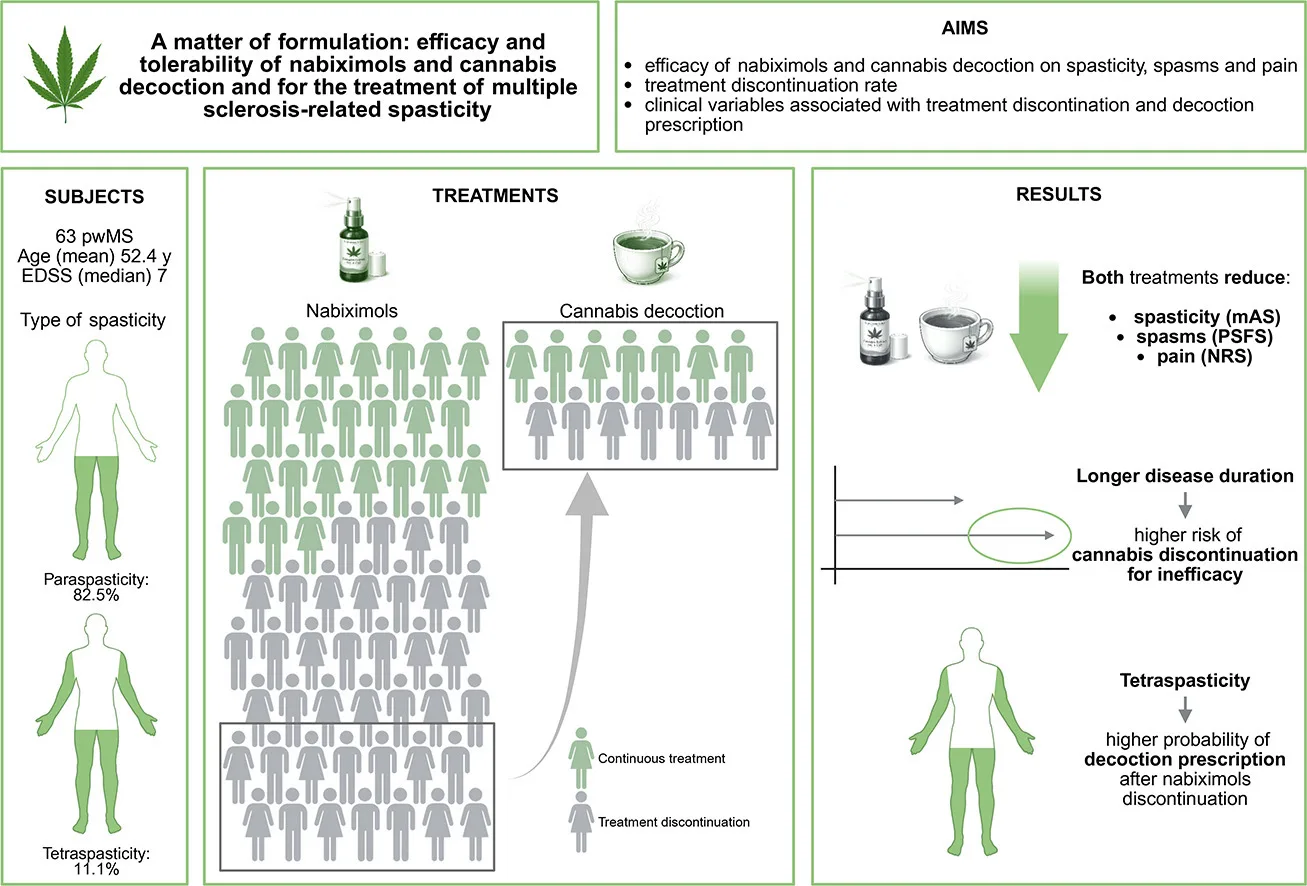
Researchers also found that patients with tetraspasticity, involving all four limbs, were more likely to switch from nabiximols to a cannabis decoction.
“Our retrospective, single-centre study demonstrates that both nabiximols and cannabis decoction effectively improve spasticity, spasms, and pain” in people with multiple sclerosis, the researchers concluded.
They said cannabis decoctions may provide a therapeutic alternative for patients who stop using nabiximols because of insufficient effectiveness or tolerability concerns.
The researchers cautioned that the findings are preliminary because the study was retrospective, involved a relatively small number of patients and was conducted at a single treatment center. They called for prospective studies to confirm the results and determine the most effective cannabinoid compositions and administration methods.