Prolonged exposure to extreme heat can reduce THC and CBD production in cannabis plants while triggering substantial biochemical and genetic stress responses, according to a new study published in the journal Plant Stress.
Researchers from Kangwon National University in South Korea, the Institute of Cannabis Research at Colorado State University Pueblo and the Chuncheon Bioindustry Foundation examined how cannabis responds to sustained high temperatures. The study involved Pink Pepper, a CBD-rich hemp variety developed for cannabis research.
Plants were exposed to temperatures of 45 degrees Celsius, or 113 degrees Fahrenheit, for periods of 40, 80 and 160 hours. Researchers measured cannabinoid levels along with biochemical indicators of cellular damage and analyzed changes in gene activity following the longest exposure period.
After 80 hours of heat exposure, total THC and total CBD levels began to decline compared with control plants. The reduction coincided with decreased activity in genes responsible for cannabinoid biosynthesis, suggesting the heat was interfering with the plant’s ability to produce the compounds rather than simply causing cannabinoids already present to degrade.
The plants also showed substantial signs of physiological stress. Hydrogen peroxide and malondialdehyde, indicators associated with oxidative stress and damage to cell membranes, increased to 7.79 and seven times control levels after 40 hours of exposure and remained elevated through 160 hours.
At the same time, the plants activated several defensive responses. Total phenolic compounds increased nearly tenfold, while flavonoids increased almost ninefold after prolonged heat exposure. Proline and soluble carbohydrates, compounds that can help plants cope with environmental stress, also increased substantially.
Genetic analysis after 160 hours found increased activity among genes involved in heat-shock proteins, protein folding and other cellular protection mechanisms. In contrast, pathways involved in photosynthesis, carbohydrate metabolism and cannabinoid production were suppressed.
The researchers said rising global temperatures could threaten cannabis productivity and the stability of commercially important compounds such as THC and CBD. They said the findings provide additional insight into how cannabis responds to prolonged heat and could help researchers develop varieties better able to maintain cannabinoid production under increasingly hot growing conditions.
The findings are particularly relevant to outdoor cannabis cultivation as extreme heat events become more common. However, the experiment used a single CBD-rich hemp variety under controlled conditions, meaning additional research involving different marijuana and hemp varieties and more typical field temperatures will be needed to determine how broadly the results apply.
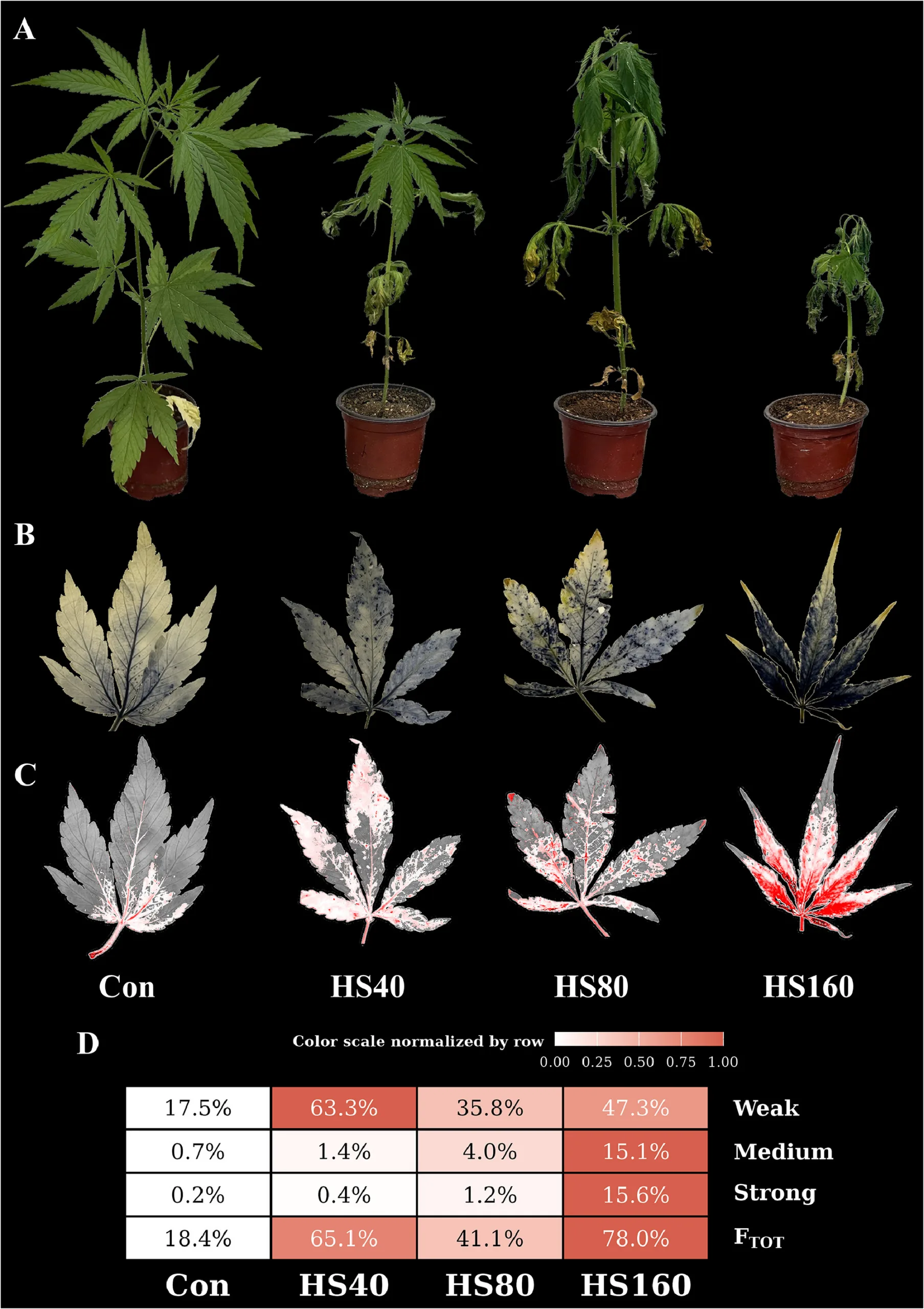
Fig. 1. Morphological responses and histochemical detection of superoxide radical in Cannabis sativa L. cv. Pink Pepper plants exposed to heat stress (45 ± 2 °C). Control plants (Con) were grown at 23 ± 2 °C; while heat-stressed plants were exposed to elevated temperature for 40 h (HS40), 80 h (HS80), and 160 h (HS160). A: Whole-plant morphological responses of C. sativa cv. Pink Pepper to progressive heat stress over time, B: Leaf-level distribution of superoxide radicals visualized by Nitro Blue Tetrazolium (NBT) staining under control and heat stress conditions, C: Digital image-based quantification of superoxide radical accumulation derived from NBT-stained leaves, D: Quantitative classification of NBT-stained leaf areas based on pixel intensity thresholds. The values for Weak (low-intensity), Medium (moderate-intensity), and Strong (high-intensity) represent the percentage of the stained area relative to the total leaf area. FTOT indicates the sum of these stained areas.