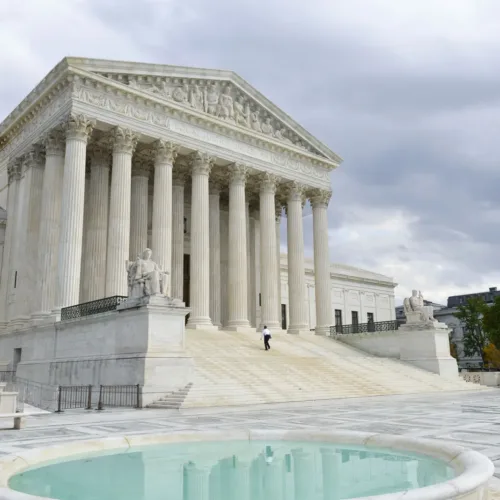
The U.S. Supreme Court is scheduled to consider Monday whether to hear a Michigan marijuana-impaired-driving case challenging the state’s lack of a numerical THC threshold for determining when a driver is legally impaired.
The case, Ricky Darnell Patterson v. Michigan, was distributed for the justices’ September 28 conference. Patterson is asking the court to review whether drivers receive constitutionally adequate notice of what level of THC in their bloodstream can expose them to prosecution when Michigan has no specific numerical impairment limit.
Patterson was charged with operating while intoxicated causing serious impairment of a bodily function following a September 2024 collision in Jackson, Michigan. According to his petition, a motorcyclist struck the side of Patterson’s vehicle after Patterson entered an intersection.
A blood test found 4.6 nanograms per milliliter of active THC in Patterson’s system. However, a Michigan State Police trooper who conducted field sobriety testing testified that Patterson showed no indications of being under the influence during the tests, according to the Supreme Court filing.
A district court nevertheless found probable cause to send the case forward, and a circuit court upheld that decision, concluding there was sufficient evidence at the preliminary stage to find Patterson likely operated his vehicle while under the influence of marijuana. The Michigan Court of Appeals declined to hear his appeal in September 2025, followed by the Michigan Supreme Court in November.
Patterson’s petition argues that the absence of a defined THC threshold leaves drivers without adequate notice of what blood concentration constitutes unlawful impairment. It asks the justices whether Patterson had “actual notice” of an acceptable THC level while driving and whether the issue is capable of repetition while evading judicial review.
Unlike alcohol, Michigan law does not establish a comparable numerical THC concentration that by itself defines marijuana impairment. State law instead prohibits driving while under the influence of a controlled substance, with impairment generally requiring evidence that marijuana affected the person’s ability to drive.
Michigan courts have previously held that the presence of marijuana alone does not necessarily establish impairment in circumstances protected by the state’s marijuana laws. In People v. Koon, the Michigan Supreme Court held that being under the influence requires “something more” than merely having marijuana in a person’s system.
Monday’s conference does not mean the Supreme Court has agreed to hear Patterson’s case or will rule on the underlying marijuana DUI question. The justices will instead consider whether to grant the petition for certiorari and take up the case.