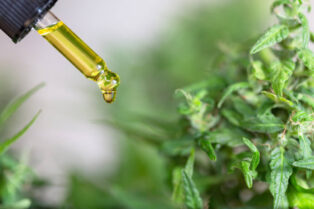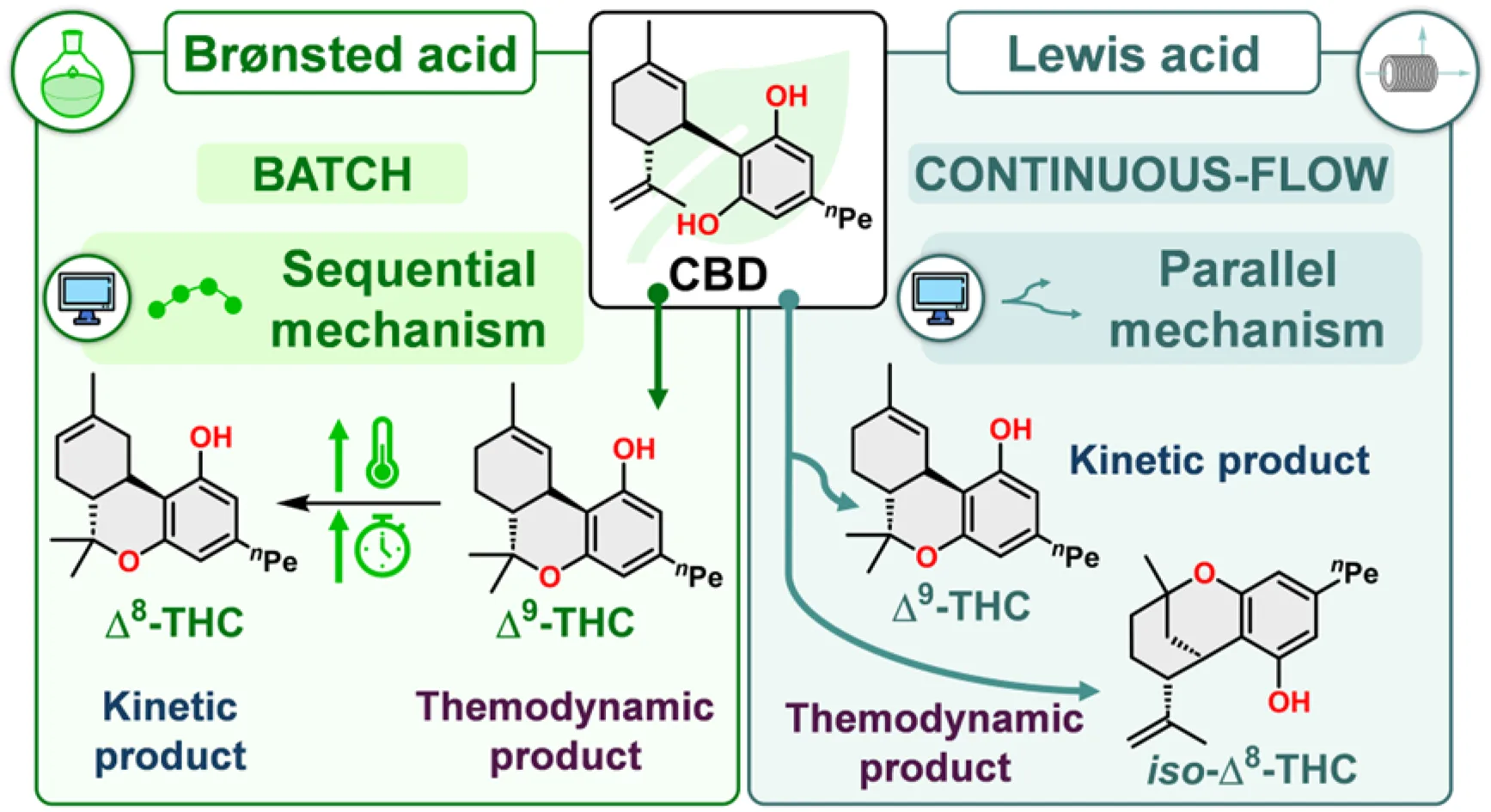
A new study provides a more detailed explanation of how temperature and catalyst type influence whether acid-catalyzed conversion of cannabidiol (CBD) produces primarily delta-9 THC, delta-8 THC or iso-delta-8 THC.
Published in the journal Organic & Biomolecular Chemistry, the study combined laboratory experiments with computational modeling to examine the acid-catalyzed conversion of CBD into THC-type cannabinoids.
CBD serves as an important chemical precursor to THC cannabinoids because it can undergo intramolecular cyclization when exposed to acid. However, researchers said the factors determining which THC isomer forms under different conditions have remained unclear.
The researchers tested two types of catalysts: p-toluenesulfonic acid, also known as p-TsOH, and boron trifluoride, or BF3. The reactions were conducted using batch and continuous-flow systems.
“Experimentally, product distribution is strongly temperature-dependent,” states the study.
Lower temperatures favored the production of delta-9 THC under both catalytic conditions. When p-TsOH was used under harsher conditions, delta-9 THC and delta-8 THC began converting into one another, eventually resulting in greater concentrations of delta-8 THC.
BF3 produced a different outcome. At higher temperatures and with longer reaction times, the Lewis acid catalyst favored the formation of iso-delta-8 THC rather than conventional delta-8 THC.
Computational simulations indicated that the catalysts also produced THC cannabinoids through different chemical pathways. BF3 promoted parallel pathways capable of producing delta-9 THC and iso-delta-8 THC. The p-TsOH reaction followed a sequential process in which CBD first cyclized before undergoing double-bond isomerization.
The calculations identified delta-9 THC as the kinetic product, meaning it forms more rapidly because its production requires overcoming a lower activation-energy barrier.
Delta-8 THC and iso-delta-8 THC were more thermodynamically stable under certain conditions. Delta-8 THC was favored under the Brønsted acid conditions produced by p-TsOH, while iso-delta-8 THC was favored under the Lewis acid conditions produced by BF3.
“Overall, regioselectivity emerges from the interplay between temperature and catalyst type,” researchers concluded.
The findings provide a clearer explanation of how reaction conditions influence the conversion of CBD into specific THC isomers, potentially supporting more controlled and predictable cannabinoid manufacturing processes.